Ball Speed
Launch speeds vary; the speed at drop barely does.
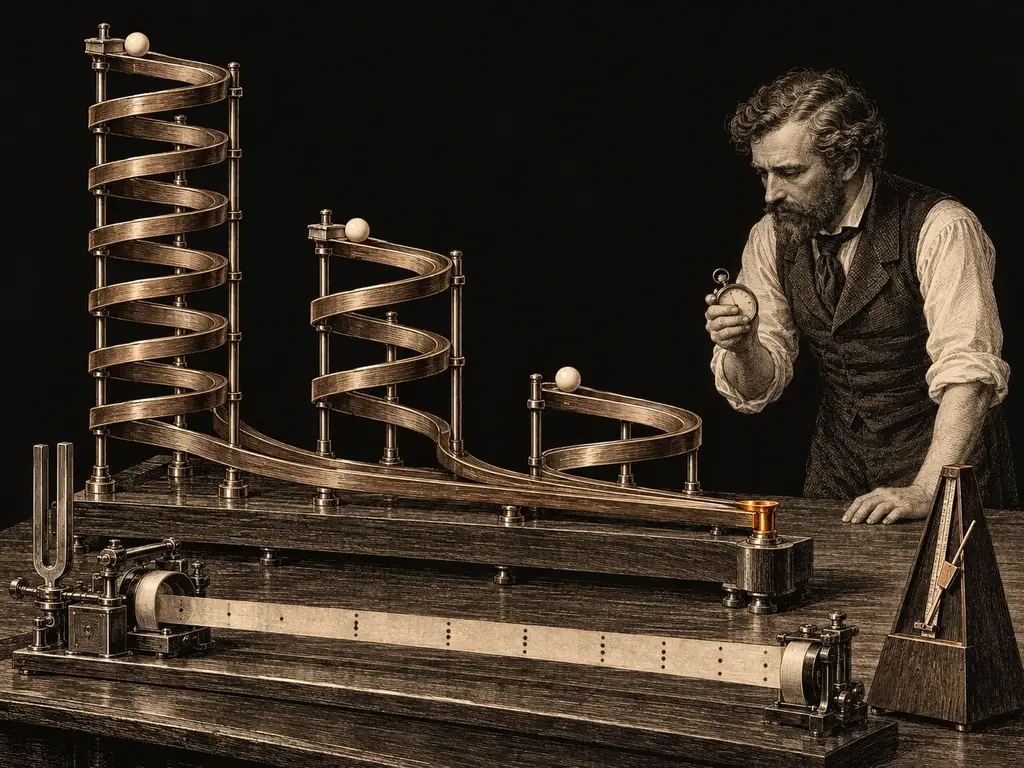
A ball may be launched at 3–4 m/s and leaves the track at roughly 1–1.3 m/s regardless. Launch speed decides how long the flight lasts, not where it ends.
Launch
A dealer flicks the ballequipmentBallThe small ball launched along the track against the rotor. Modern balls are ivorine or Teflon, 18–21 mm.Read full → into the track at three to four meters per second, which on an 80 cm wheel is a lap in about 0.6 seconds. Launch speed varies by dealer and by round; a hard launch gives twenty laps, a soft one eight. Studios require a minimum number of revolutions, commonly four or more, so that no spin is short, because the fewer laps there are, the less the ball decelerates and the easier the drop is to time from the launch alone.
Deceleration
Lap times grow roughly geometrically as the ball slows: if one lap takes 0.8 s the next might take 0.9, then 1.0, then 1.15. Fit the growth from two or three laps and the remaining laps follow. The table below shows a made-up but realistic sequence; the deceleration page gives the model behind it.
At the drop
The ball leaves the track at a speed set by the track’s tilt and radius, not by how it was launched, so the speed at drop is nearly constant across spins on a given wheel: about 1 to 1.3 m/s. That constancy is what makes the drop timeable. What happens next, the apronequipmentApronThe sloped area between the ball track and the pockets, where the deflectors sit.Read full → and the deflectorsequipmentDeflectorOne of the metal obstacles on the apron that scatter the falling ball. Also: canoe, diamond, pin.Read full →, takes the nearly constant input and produces a widely scattered output.
Why studios set minimums
With four or more laps the ball passes through enough deceleration that the launch speed is irrelevant to the drop timing and must be measured in flight. With one or two laps a predictor could estimate the drop from the launch alone. Minimum revolutions are the studio’s cheapest defense, after closing bets early.
Measuring from a stream
Count the ball passing a fixed deflector and note the stream’s timestamps. You will reproduce the pattern above and learn how your table’s dealers launch. You will not change your odds, because betting closed before the ball slowed.
Questions
It changes how long the flight is and so where the rotorequipmentRotorThe spinning part of the wheel that carries the pockets.Read full → is when the ball drops. The scatter afterwards is the same.
Habit, or a house instruction to vary. Consistency is what predictors want.
Comic relief
The launch sets the laps. The track sets the drop.
Sources
- Small, M. & Tse, C. K. “Predicting the outcome of roulette.”
- Bass, T. A. The Eudaemonic Pie.