Blaise Pascal
The mathematician usually credited with the wheel, who was trying to build something else.
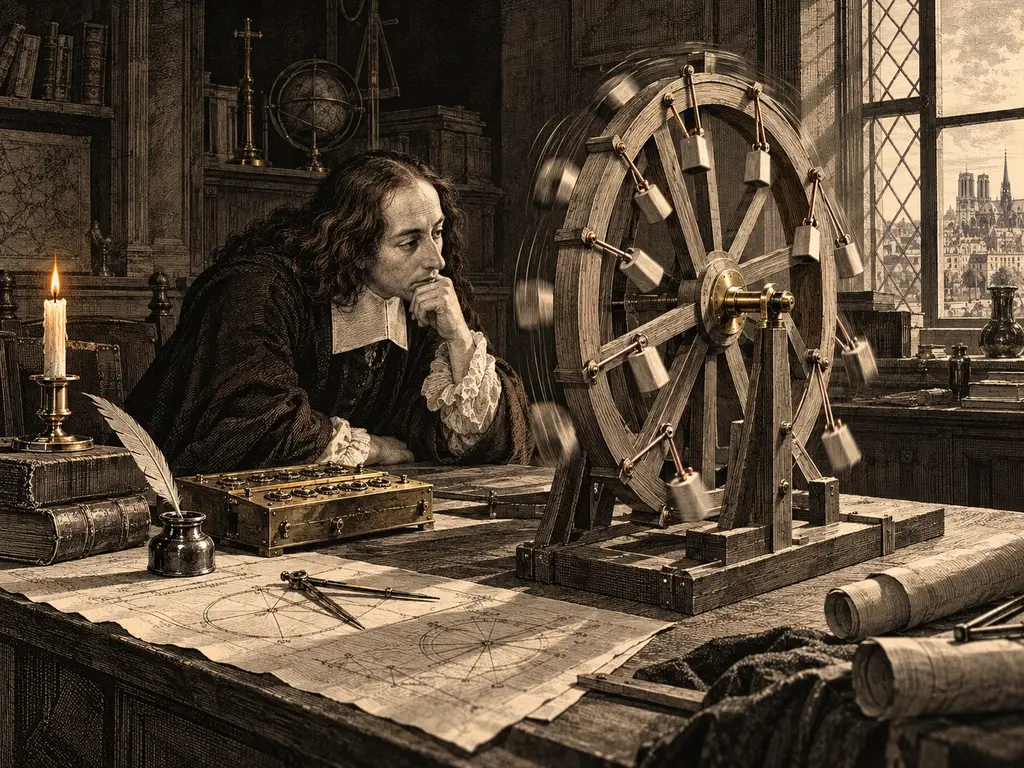
Pascal (1623–1662) experimented with perpetual-motion devices in the 1650s. The near-frictionless spinning wheel attributed to him is a plausible ancestor of the roulette rotor; the attribution is traditional rather than documented.
The mathematician
Blaise Pascal built a mechanical calculator at nineteen, proved results in projective geometry as a teenager, did foundational work on pressure and vacuum, and in 1654, in letters with Pierre de Fermat, solved the “problem of points”: how to divide the stakes of an interrupted game of chance fairly. Their answer, to split according to each player’s probabilitymathProbabilityChance of an outcome, from 0 to 1 or 0% to 100%. One number: 1/37 = 2.70%.Read full → of winning had the game continued, is the origin of expected valuemathExpected valueThe average result per bet over the long run. −1/37 of the stake for every standard European bet.Read full →. Every EV calculation on this site descends from those letters.
The wheel
In the mid-1650s Pascal worked on a perpetual-motion machine and is said to have built a finely balanced wheel that spun for a long time with little friction. The story that this wheel became the roulette rotorequipmentRotorThe spinning part of the wheel that carries the pockets.Read full → is repeated in many histories and documented in none of the primary sources. It is plausible that spa-town operators in the 18th century used the name as a selling point. It is not something the Lab would accept on the evidence.
Probability, in his words and ours
The 1654 letters do not mention roulette, which did not yet exist. They ask: two players need three points to win a pot; they stop at 2–1; how should the pot be split? Pascal’s answer uses what we would now call conditional expectation and a recursive argument down the tree of possible continuations. Huygens read the correspondence and in 1657 published the first textbook on expectation. The word “expectation” is his.
Pascal and Fermat solve the problem of points: expected value as the fair price of a position.
Huygens, De Ratiociniis in Ludo Aleae: the first printed treatment of expectation.
Jakob Bernoulli, Ars Conjectandi: the law of large numbers.
Roulette described in Paris. Every payout is 36/n − 1: EV = −1/37 (or −2/38).
Pearson’s chi-square test, demonstrated on roulette spins.
All of the above, on this site, in a browser.
The wager
Pascal’s most famous argument about betting is not about roulette but about God: the “wager” in the Pensées that frames belief as a bet with infinite payoff. It is an expected-value argument, and it is the first time anyone used decision theory to argue for anything. Roulette players who invoke Pascal for the wheel are invoking the wrong Pascal; the one who matters is the one who showed how to price a gamble.
The irony
Whether or not Pascal built the first roulette wheel, the game is a neat illustration of his real work: a device from a man who proved you cannot get something for nothing (perpetual motion fails; expectation is conserved), used to demonstrate the same thing to a few million players a year.
Questions
He moved in gambling circles in Paris in the early 1650s, which is how the problem of points reached him via the Chevalier de Méré. There is no record of him playing for money seriously.
Because it is a good story and because 19th-century casino promoters liked it. Repeat it with a footnote.
Comic relief
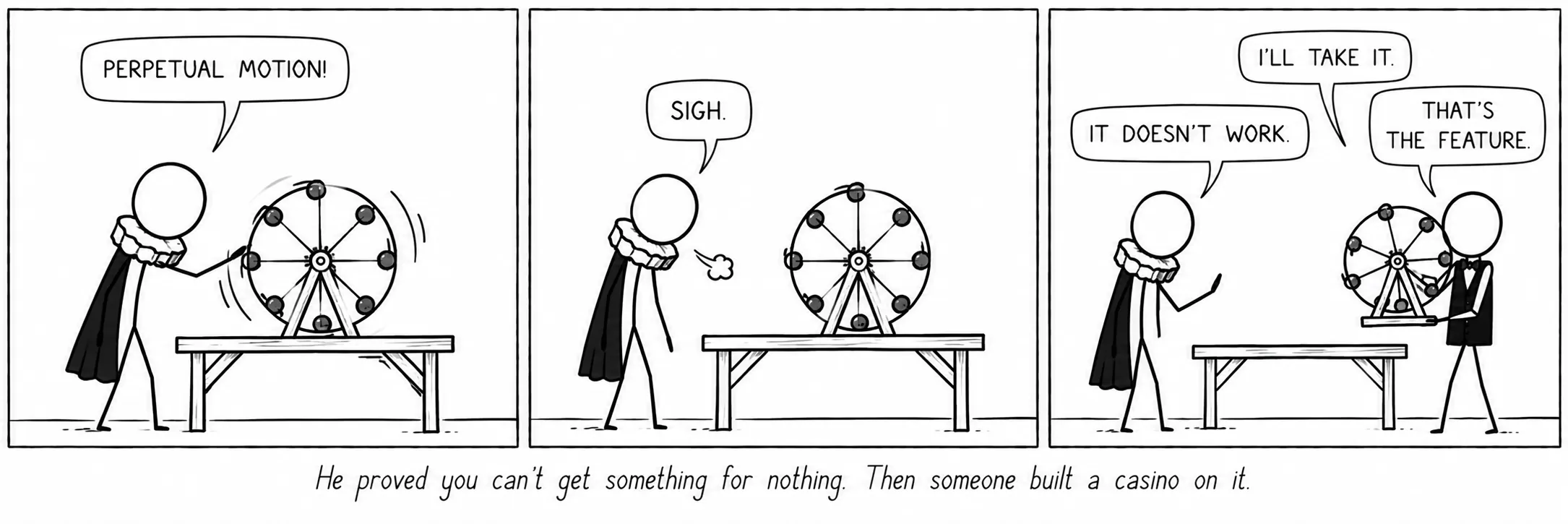
He proved you can’t get something for nothing. Then someone built a casino on it.
Sources
- Pascal, B. & Fermat, P. Correspondence on the problem of points.
- Huygens, C. De Ratiociniis in Ludo Aleae.
- Kavanagh, T. M. Dice, Cards, Wheels: A Different History of French Culture.