Dealer Procedure
What the dealer does, in order, and why each step is there.
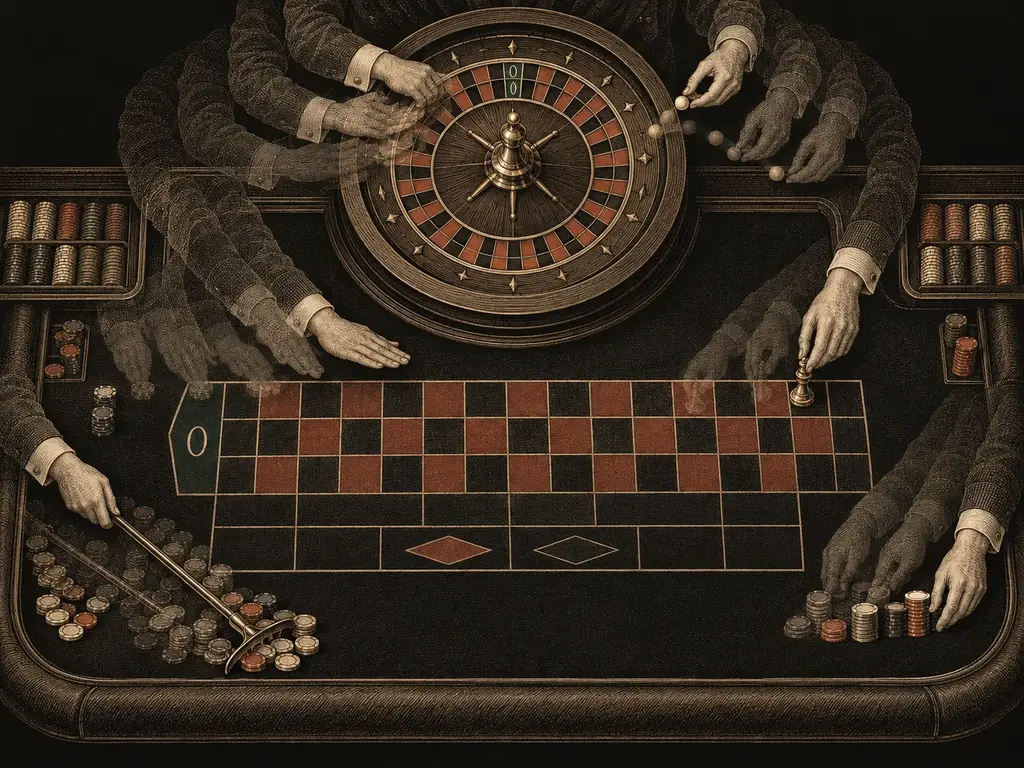
Open bets, spin rotor, launch ball, call no more betsprocedureNo more betsThe dealer’s call (or the on-screen prompt) that closes betting. Chips may no longer be placed, moved or removed.Read full →, announce result, mark with dolly, clear losers, pay winners, lift dolly, repeat.
The sequence
Dealers are trained to a fixed sequence so that every round is auditable and every player knows what is coming. The order below is standard across casino floors and studios; the timing differs.
Lift the dolly. “Place your bets.” The layout is open.
Keep the rotor turning; give it a push to maintain speed.
Launch the ball from above the last winning pocket, against the rotor direction, hard enough for the minimum revolutions.
Watch the ball. At three or four laps remaining, wave and call “no more bets”.
Ball settles. Announce number and color. Confirm on screen (studio).
Place the dolly on the winning cell.
Sweep losing chips, outside bets first, then inside.
Pay winners: outside first, then inside, nearest the dealer last.
Check the layout. Lift the dolly. Repeat.
Spin and launch
The rotorequipmentRotorThe spinning part of the wheel that carries the pockets.Read full → is never stopped between rounds; a push keeps it at roughly a third to half a revolution per second. The ballequipmentBallThe small ball launched along the track against the rotor. Modern balls are ivorine or Teflon, 18–21 mm.Read full → is launched from the rim above the pocketequipmentPocketOne of the 37 numbered compartments on the rotor. Also: slot, cup.Read full → that just won, in the direction opposite to the rotor. Many houses require the dealer to alternate rotor direction between rounds. Studios specify minimum ball revolutions (commonly four or more) so that no spin is “short”, because a short spin is the most predictable kind.
Closing bets
Called when the ball visibly slows, roughly three to four revolutions before it drops. A dealer who calls too late gives a timing player a window; too early and the table loses betting time. Online, the server closes bets at a fixed point in the sequence, usually around the launch, and the dealer’s wave is ceremonial.
Settling
Losing chipsmoneyChipA token representing a fixed amount, placed on the layout to make a bet. Also: check.Read full → are swept first so the layoutequipmentLayoutThe printed betting grid on the table. Also: table, felt, cloth.Read full → is clear. Then outside betsbetOutside betA bet on the boxes surrounding the grid: dozens, columns and even-money bets.Read full → are paid, then inside betsbetInside betAny bet placed on or between the numbers of the grid: straight up, split, street, corner, six line.Read full →, nearest the dealer last. PayoutsmoneyPayoutWhat a winning bet returns, quoted as “X to 1” on top of the returned stake.Read full → are counted out in stacks: a straight-up win of 35 chips is paid as a stack of 20 and a stack of 15, or by “cutting” a tall stack against a reference stack. The dollyequipmentDollyThe marker placed on the winning number on the layout while bets are settled.Read full → is lifted only when everything is paid, which is the signal that the layout is open again.
Dealer signatures
Because the launch is a human action, dealers develop habits: a preferred force, a rhythm of release. The hypothesis that these habits make the drop point predictable relative to the launch point is discussed in the Lab. Houses counter it by instructing dealers to vary their release and by rotating dealers between tables every 20 to 40 minutes, which is also why you rarely see the same dealer for an hour.
Questions
Convention and physics: opposite directions increase the relative speed at the drop and make the scatter wider.
You can ask; they will decline. The launch is theirs.
Typically 20 to 40 minutes before rotating. Live studios rotate on a similar schedule.
Comic relief
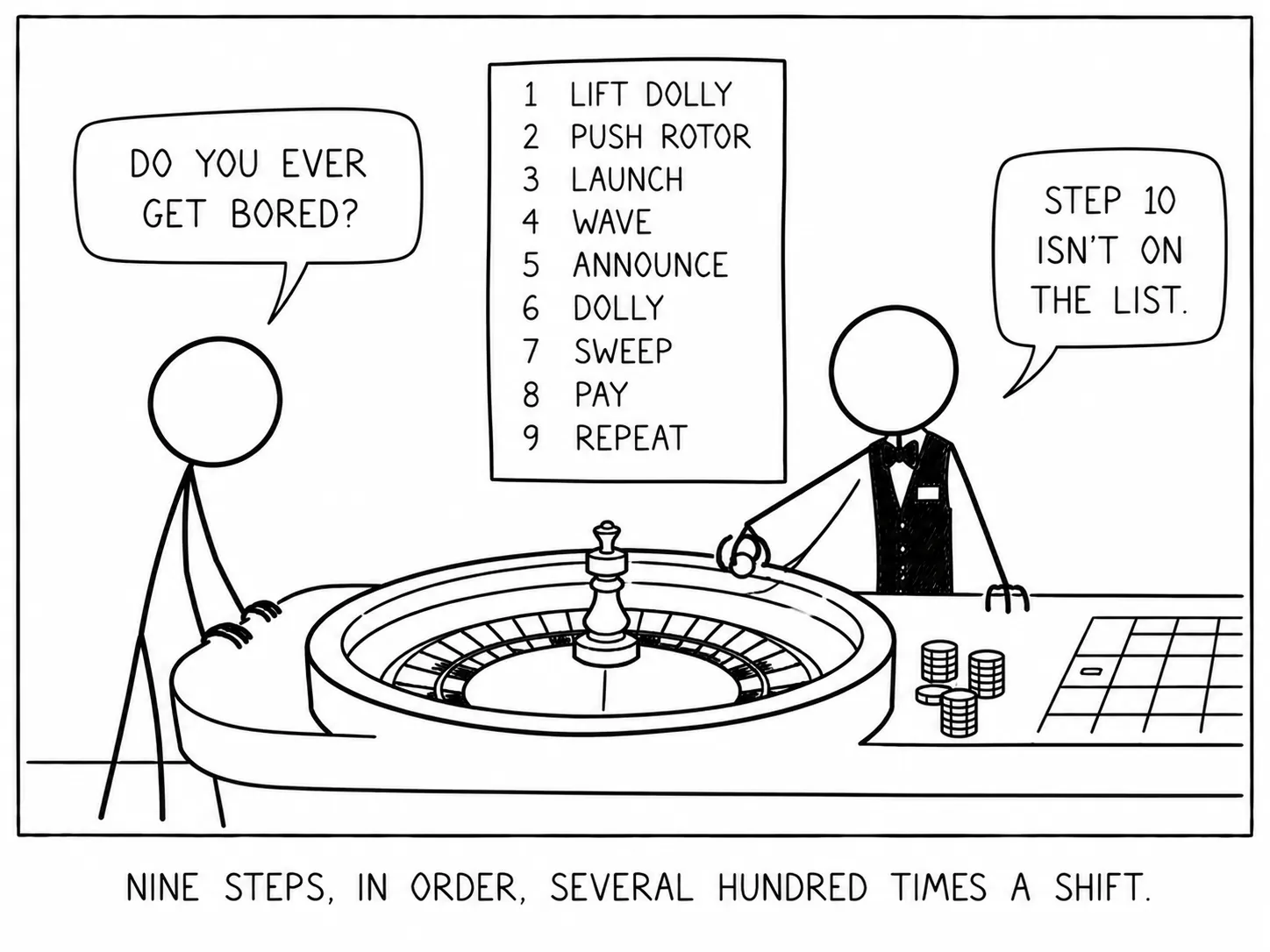
Nine steps, in order, several hundred times a shift.
Sources
- UK Gambling Commission. Remote gambling and software technical standards.
- Malta Gaming Authority. Gaming Devices Regulations and technical directives.
- Wykes, A. The Complete Illustrated Guide to Gambling.