Gonzalo García-Pelayo
A record producer, a family of note-takers, and a Supreme Court that told the casino to mind its wheels.
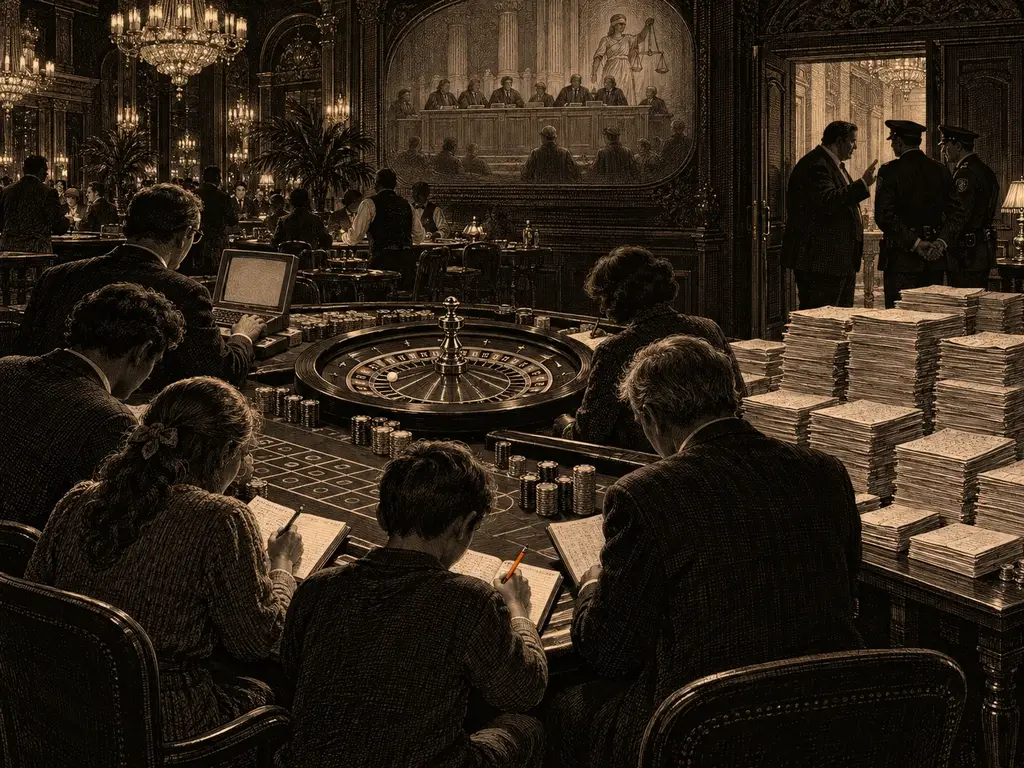
Gonzalo García-Pelayo (born 1947), a Spanish record producer and film director, led a family team that from late 1991 recorded about 5,000 spins per wheel at Casino Gran Madrid and bet the pockets that ran ahead. He puts the winnings at 200 to 250 million pesetas across several casinos. The casino barred the family, the government overruled the ban, and in 2004 the Supreme Court sided with the players.
Before the casino
Gonzalo García-Pelayo was born in Madrid on 25 June 1947 and grew up in Andalusia, in Jerez and Seville. He directed films, among them Manuela (1976) and Vivir en Sevilla (1978), and in 1974 he founded the record label Gong, where he produced Triana, Lole y Manuel and María Jiménez. By his own count he produced about 150 records. He is not a mathematician, whatever some newspapers wrote: he told the business daily Cinco Días in 2004 that he had only school mathematics and a book or two on probabilitymathProbabilityChance of an outcome, from 0 to 1 or 0% to 100%. One number: 1/37 = 2.70%.Read full →. The idea of studying roulette came to him, he says, after losing at blackjack.
The team
The players were his family. His own site names his son Iván, his daughter Vanessa and his nephews Christian and Marcos; other accounts add the nephews Guillermo and Jaime. Six people were covered by the casino’s ban, and by his later telling the group grew to twelve, with more relatives and a few close friends. They called themselves the flotilla.
The work was divided. Some sat at a wheel and wrote down the numbers; when they had finished they left and new faces came in to bet, so that the casino would not connect the two. He rarely placed a bet himself. Others played and telephoned him the result. Later they used friends the casinos did not know, whom they called submarines.
The method, in his words
His starting point is that no machine is perfect: if Swiss watches and NASA rockets are not, a roulette wheel is not either, and some pocketsequipmentPocketOne of the 37 numbered compartments on the rotor. Also: slot, cup.Read full → must win a little more often than the rest. At first he suspected the croupierpeopleCroupierThe dealer at a roulette table.Read full →’s throw; the numbers showed that the cause was the wheel.
Each wheel was recorded for about 5,000 spins before anyone bet on it (Iván has said 6,000), which took some fifteen days at six to eight hours a day. The recorders also learned the wheel’s marks, down to the smallest scratch, so that it could be found again if it was moved.
He counts in “positives”. A number that comes up once in 36 spins breaks even at 35 to 1, so it scores nothing; every hit beyond that is one positive. He then compares a wheel’s positives with what fair wheels produce in a computer simulation, using a program he wrote himself. As a reviewer of the family’s book reports it, there are two limits: one that 95% of simulated fair wheels stay under, and a hard limit that 99.95% stay under. A wheel beyond the hard limit is, for him, certainly biased.
By his figures a biased wheellabBiased wheelA wheel whose physical defects make some pockets more likely than 1/37. Rare, detectable only with thousands of recorded spins.Read full → had between nine and twelve numbers running ahead. The best pocket he ever found won once in 28 spins, anything better than once in 35 was worth a bet, and the mix gave an advantage of about 6%. All of these numbers are his; no casino or regulator has published any.
Why 5,000 spins, and why the whole wheel
In 5,000 spins a fair pocket comes up about 135 times, give or take 11. A pocket that really wins once in 28 comes up about 179 times, nearly four of those “give or takes” ahead; luck does not do that, and the pocket is plainly faulty.
A pocket that wins once in 33 is a different matter. It would earn a bettor 9%, and in 5,000 spins it comes up about 152 times, only one and a half “give or takes” ahead. On a perfectly fair wheel two or three of the 37 pockets will be that far ahead by luck alone. Picking the leading number after 5,000 spins is therefore not enough. The whole wheel has to be tested against what fair wheels do, which is what the simulated limits are for, and what the chi-square testlabChi-square testStatistical test comparing observed hits per pocket with the expected n/37. Used to judge whether a wheel is biased.Read full → does on paper.
The money
The family is the only source for the winnings, and the figures vary. The overall total is the steadiest: between 200 and 250 million pesetas from all casinos, which is 1.2 to 1.5 million euros. For Casino Gran Madrid alone, different accounts give anything from 70 million pesetas to more than a million euros. The casino told El País in 2000 that it had no record of the sum. He says they started with about 1,800 euros and once lost 60,000 euros in a day.
The family played elsewhere too, by his account: Barcelona, Vienna, Amsterdam, Copenhagen. Las Vegas was the last attempt and paid poorly, because of the second zerowheelZeroThe single green pocket that no even-money, dozen or column bet covers; the source of the house edge. Also: single zero, 0.Read full →. With 38 pockets a pocket has to be that much more faulty before a 35 to 1 payoutmoneyPayoutWhat a winning bet returns, quoted as “X to 1” on top of the returned stake.Read full → shows a profit.
What the casino did
Casino Gran Madrid stands at Torrelodones, outside the city, and Spanish newspapers often call it simply the Casino de Madrid. By the family’s account it first moved the wheels and changed parts of them, so that each had to be studied again. Then it barred the players, under the article of the Spanish casino regulations that lets a casino refuse people expected to commit irregularities at the games. Its case, as El País reported it, was that the group had spent a long time working out how often each result came up, used a computer program to predict results, and so played with an advantage. It also complained that other players copied their bets.
Other casinos were warned. The family describes being asked to leave in Vienna after a winning night, and in 2012 he said they were still barred in France and Denmark.
Ten years in court
The casino did not sue the family. The family complained about the ban to the government’s office in Madrid, which ruled it improper, and it was the casino that went to court, against the government’s decision.
The family begins recording wheels at Casino Gran Madrid.
They win steadily. During the Barcelona Olympics one team plays in Madrid and another in Barcelona.
The casino bars six of them.
The government’s office in Madrid declares the ban improper. The casino goes to court.
The High Court of Justice of Madrid dismisses the casino’s challenge.
The Supreme Court rejects the casino’s appeal.
The feature film The Pelayos is released in Spain.
What the Supreme Court said
The court held that what the players did was not an irregularity in the sense of the regulations, so the casino had no ground to keep them out. In its words, the players had done nothing more than use their ingenuity and apply computer techniques, and their play rested on simply observing results that repeat, not on breaking the rules. It put the cause in the wheels: very slight flaws of construction or placement, invisible to the naked eye.
It also said what a casino may do instead. The lawful defense is not to expel or bar the players but to change where the wheels stand, exchange their components or improve their design.
The ruling is narrower than it is often made to sound. It applies one article of Spain’s casino regulations to one ban. It does not say that every casino everywhere must admit a player who has found a biased wheel.
After roulette
He learned poker in the United States and opened a Texas hold’em club in Madrid in 1996; El Mundo reported in 2001 that Carlos Mortensen, world champion that year, had learned the game there. By 2004 he was living from online poker, and later he turned to sports betting. With Iván he wrote La fabulosa historia de los Pelayos (2003). The History Channel told the story in its series Breaking Vegas, and Eduard Cortés filmed it as The Pelayos (2012). He went back to directing films the same year.
What is not established
Three things often said about the Pelayos have no source beyond the family, or none at all. He says an English maker built a special wheel against them, an “anti-Pelayo roulette”; no maker or casino has confirmed it. Nothing shows that casinos across Europe changed their maintenance because of this one family. And the tables of limits in the book could not be checked for this page, so they are described here only as a reviewer described them.
Questions
No. The casino barred them, the government overruled the ban, and the casino took the government to court. It lost in 2000 and again in the Supreme Court in 2004.
It ruled that observing a wheel and betting on what it shows is not an irregularity under Spain’s casino regulations, so this ban was improper. It decided nothing for other countries.
He said in 2004 that it then returned 2.7% where it had once reached 6%, and that the people he knew who tried it in Madrid did it badly and lost.
Comic relief
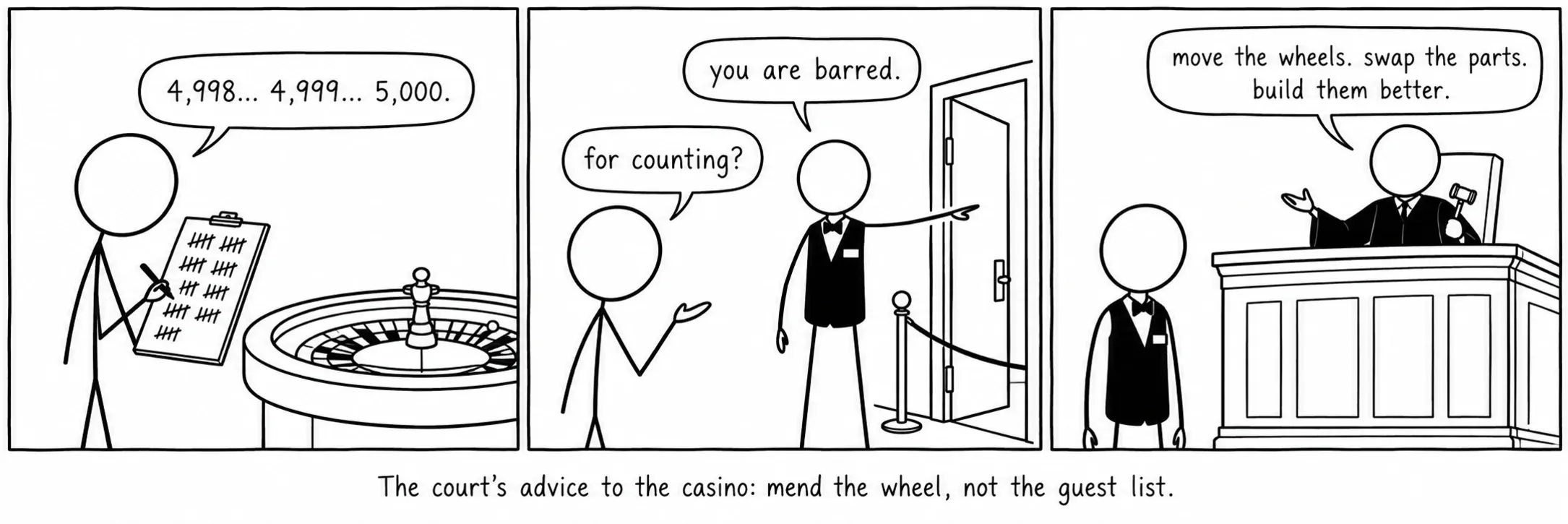
The court’s advice to the casino: mend the wheel, not the guest list.
Sources
- Tribunal Supremo, Sala de lo Contencioso-Administrativo.
- Hernández, J. A. “El clan de los Pelayo gana la apuesta.”
- Sampedro, J. “Los ‘tecnotahúres’ vuelven al casino.”
- Cadena SER. “Los Pelayo ya pueden entrar en el Casino de Madrid.”
- Mazo, V. “Pelayos contra el Ibex 35.”
- Semana. “El terror de la ruleta.”
- Solomita, M. “La increíble historia de Gonzalo García-Pelayo, el hombre que venció a la ruleta.”
- Wille, G. “Hicimos saltar la banca.”
- Ibáñez, Á. “La Fabulosa Historia de Los Pelayos.”
- Mazarrasa, L. Feature on poker in Spain.
- García-Pelayo, G. “Análisis de una ruleta.”