Odd / Even
Eighteen odd or eighteen even numbers. Zero is neither.
Pays 1:1, probabilitymathProbabilityChance of an outcome, from 0 to 1 or 0% to 100%. One number: 1/37 = 2.70%.Read full → 48.65%. Identical odds to red/black.
Placement
The “Even” and “Odd” boxes in the outside row, between the dozensbetDozen1–12, 13–24 or 25–36, pays 2:1.Read full → and the color diamonds; pair and impair on a French layoutequipmentLayoutThe printed betting grid on the table. Also: table, felt, cloth.Read full →. Each must meet the table minimum.
Note on zero
ZerowheelZeroThe single green pocket that no even-money, dozen or column bet covers; the source of the house edge. Also: single zero, 0.Read full → is even in arithmetic (it is divisible by two) and loses for both odd and even bets at the roulette table. The layout settles the question by not listing zero in either box. Beginners sometimes argue the point; dealers have heard it before.
Odd/even versus red/black
Mathematically identical: 18 numbers, 1 to 1, 48.65%. The two pairs of bets differ only in which eighteen numbers they cover, so a combination like “redbetRedEven-money bet on the 18 red numbers. French: rouge.Read full → and even” covers 28 numbers with a double hit on the eight numbers that are both red and even (12, 14, 16, 18, 30, 32, 34, 36). The Bet Builder computes any such overlap.
Ten red, eight black
Odd and red are not the same eighteen numbers. Ten of the odd numbers are red and eight are blackbetBlackEven-money bet on the 18 black numbers. French: noir.Read full →: red 1, 3, 5, 7, 9, 19, 21, 23, 25 and 27; black 11, 13, 15, 17, 29, 31, 33 and 35. The even numbers split the other way, eight red and ten black. So red plus odd covers 26 numbers, ten of them twice, where red plus even covers 28.
Payout and expectation
Fair odds against 18 in 37 are 1.056 to 1; the table pays 1. Over 37 average spins at $10, a bet on even wins 18 times (+$180), loses to the eighteen odd numbers (−$180) and loses to zero once (−$10): −$10 on $370 staked, 2.70%. On a double-zero wheel there are two zeros to lose to, and the cost is $20 on $380, 5.26%.
On the wheel
Odd and even are mixed around the rim so that no arc favors either. The sequence is arranged in pairs: looking at the wheel, two odd numbers are usually followed by two even ones. Like all outside betsbetOutside betA bet on the boxes surrounding the grid: dozens, columns and even-money bets.Read full → it covers no sectorwheelSectorA contiguous arc of pockets on the wheel, as distinct from a group on the layout.Read full →.
French rules
With la partageruleLa partageFrench rule: when zero hits, half of an even-money stake is returned. Halves the house edge on those bets to 1.35%.Read full →, half of an odd or even bet comes back when zero is spun, and the cost falls to 1.35%. With en prisonruleEn prisonFrench rule: when zero hits, an even-money bet is held for the next spin instead of lost. Halves the house edge on those bets.Read full → the bet stays on the layout for one more spin: if it wins it is returned without winnings, and if it loses it is taken, which comes to about the same price. Whether zero counts as even never comes up, because the rule treats pair and impair alike.
A worked evening
$5 on odd for 100 spins is $500 staked, and the expected lossmathExpected lossExpected value times total amount wagered; the average amount lost over a session or a period.Read full → is $500 ÷ 37 = $13.51. The usual swing around that figure is about $50, since the standard deviationmathStandard deviationSquare root of variance; the typical distance of a result from the expected value.Read full → of 100 even-money betsbetEven-money betRed/black, odd/even, high/low. 18 numbers, pays 1:1.Read full → of $5 is 5 × √100. About two evenings in three end between $64 down and $36 up.
Questions
Yes. Odd/even is an even-money bet and gets the half-back on zero at a French table.
No mathematical reason. Some players use both to diversify streak exposure, which changes the pattern of wins and nothing about their total.
Fun with Math
Try these yourself first. Each solution is folded; open it when you are ready.
Old layoutsequipmentLayoutThe printed betting grid on the table. Also: table, felt, cloth.Read full → sometimes had a bet on “low and even” together. It won even money if the number was both low (1 to 18) and even, lost if it was neither, or zerowheelZeroThe single green pocket that no even-money, dozen or column bet covers; the source of the house edge. Also: single zero, 0.Read full →, and stayed in place if it was one but not the other. What did it cost on a European wheel?
Show the solution
Answer 2.70% per spin, but 5.26% of each bet that was actually settled.
Count the pocketsequipmentPocketOne of the 37 numbered compartments on the rotor. Also: slot, cup.Read full →. Low and even: 2, 4 … 18, nine numbers, win. High and odd: 19, 21 … 35, nine numbers, plus the zero, ten in all, lose. The other eighteen, low and odd or high and even, leave the bet where it is.
Per spin the bet wins 9 times in 37 and loses 10: −1/37, the usual 2.70%. But on 18 spins in 37 nothing happens. Counting only the spins that settle it, the bet loses 1 unitmoneyUnitThe base stake a system or a player works in. Progressions are described in units so they apply at any table.Read full → in 19, 5.26%, the American price.
On an American wheel, with 00 among the losers, it costs 5.26% per spin and 10% per settled bet. Bollman (2024) gives it as a curiosity.
Comic relief
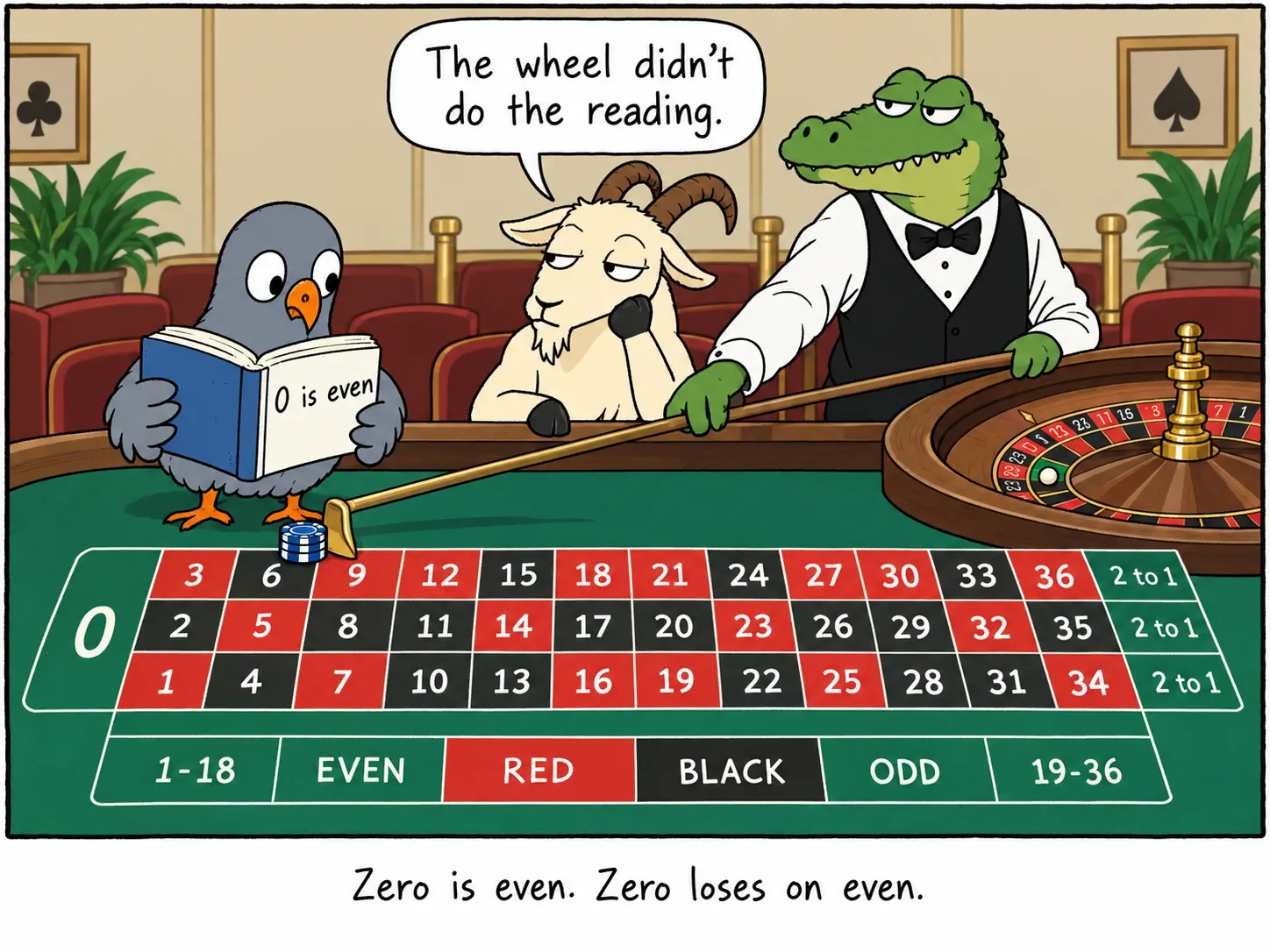
Zero is even. Zero loses on even.
Sources
- Ethier, S. N. The Doctrine of Chances: Probabilistic Aspects of Gambling.