Myth: Dealers Can Aim the Ball
“The dealer put it on zero on purpose.” The dealer cannot put it anywhere.
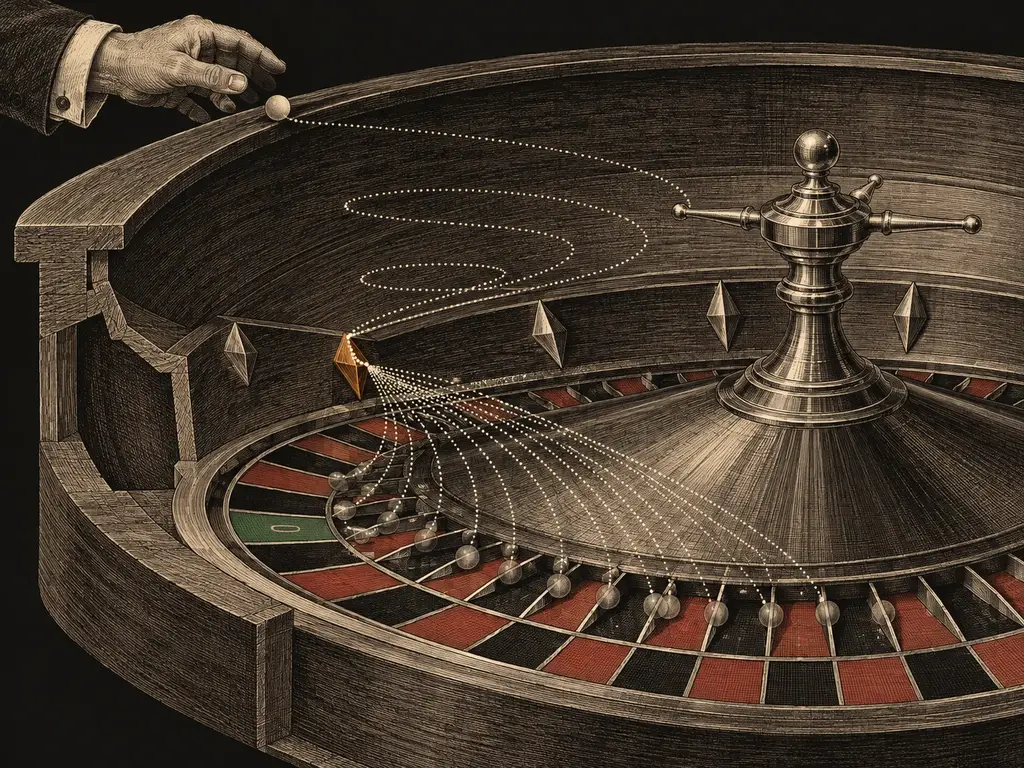
A dealer controls launch speed and rotor speed, not the deflector the ball hits or how it bounces. Scatter after the drop spans 10 to 15 pockets either side. No dealer can aim at a pocket, and studios make even sector consistency impossible.
The claim
After a losing spin, especially on zerowheelZeroThe single green pocket that no even-money, dozen or column bet covers; the source of the house edge. Also: single zero, 0.Read full →, players sometimes believe the dealer aimed the ballequipmentBallThe small ball launched along the track against the rotor. Modern balls are ivorine or Teflon, 18–21 mm.Read full →. The belief gets support from the dealer-signature hypothesis in the Lab, which asks whether a dealer’s habits make the drop sectorwheelSectorA contiguous arc of pockets on the wheel, as distinct from a group on the layout.Read full → somewhat predictable. That hypothesis is about sectors and statistics; the myth is about pocketsequipmentPocketOne of the 37 numbered compartments on the rotor. Also: slot, cup.Read full → and intent.
What a dealer can do
Set the rotorequipmentRotorThe spinning part of the wheel that carries the pockets.Read full → speed with a push and launch the ball with a chosen force. Both are approximate: a hand is not a machine. If a dealer were perfectly consistent, the ball would leave the track at a consistent point relative to the launch, and the rotor would be at a consistent phase. That is the deterministic part of the spin, and it is the part a dealer influences.
What a dealer cannot do
Control which of eight deflectorsequipmentDeflectorOne of the metal obstacles on the apron that scatter the falling ball. Also: canoe, diamond, pin.Read full → the ball strikes, at what angle, or how it bounces across the fretsequipmentFretThe metal divider between two pockets on the wheel.Read full →. These depend on millimeters of position at the drop and are the chaotic part of the spin by design. Scatter distributions measured on modern wheels spread the final pocket across 20 to 30 pockets around the drop point. A dealer who could hit a pocket on demand would be a physical impossibility, not a cheat.
Why the house would not want it anyway
The casino makes 2.70% of turnovermoneyTurnoverThe total amount wagered over a session or period, counting re-bet winnings. Also: handle, action.Read full → on every spin regardless of where the ball lands. A dealer who steered results would be stealing from the house’s own customers for no gain to the house and enormous legal risk. Studios log every spin, vary dealers every half hour, instruct them to vary release, and close bets before the launch. The incentives and the physics point the same way.
Where the grain of truth is
The dealer-signature hypothesis: with enough consistency, a dealer might produce a slight statistical tilt toward a sector relative to the launch point. Published data has not shown it; studios act as if it might exist. The Wizard of Odds, after reading Arnold Snyder on the subject, sits on the fence: a dealer working with a wheel clocker might slow a spin to help, and a very skilled one might favor a sector. A sector, not a pocket. Even if it did, it would be a few percent of edge on a sector bet, invisible in a single spin, and available to the player, not the house.
Questions
Zero is 1/37 per spin. Three in 50 spins happens about 15% of the time.
Not by aiming. Possibly by sloppy payoutsmoneyPayoutWhat a winning bet returns, quoted as “X to 1” on top of the returned stake.Read full →, which is why cameras and the double read exist.
A fixed, auditable rule. It also means the launch point is random, which is one less thing a dealer controls.
Comic relief
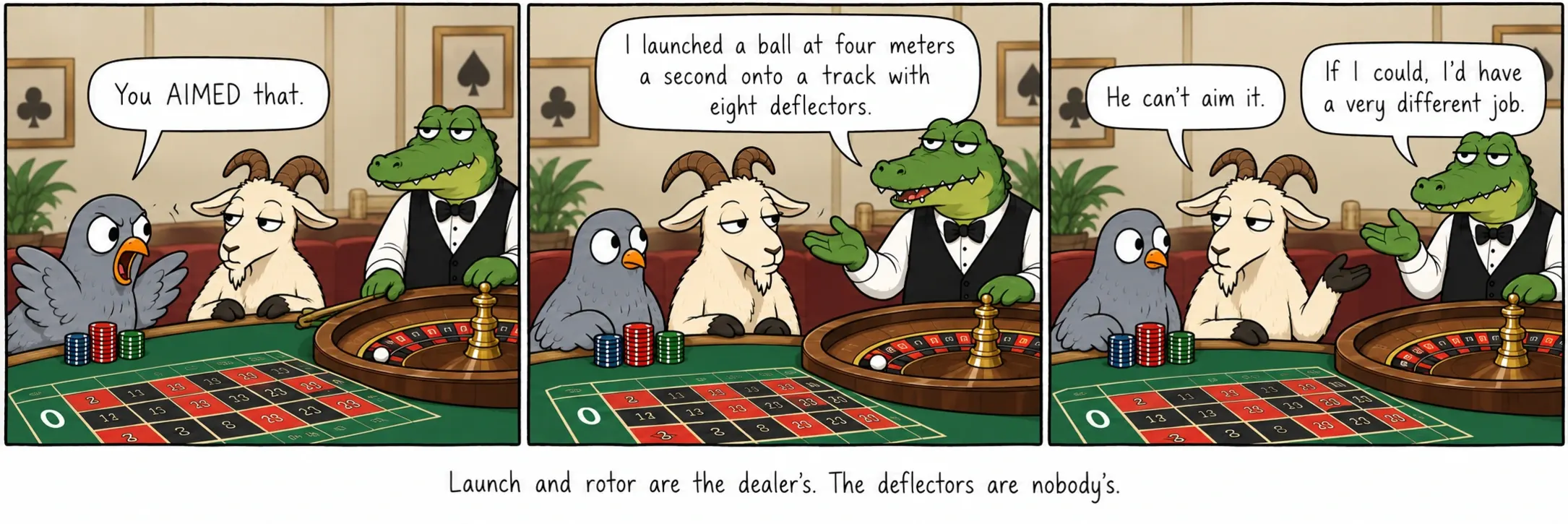
Launch and rotor are the dealer’s. The deflectors are nobody’s.
Sources
- Small, M. & Tse, C. K. “Predicting the outcome of roulette.”
- Barnhart, R. T. Beating the Wheel.
- UK Gambling Commission. Remote gambling and software technical standards.
- Wizard of Odds. “Roulette Basics”, section on ball steering.