Speed Roulette
The European game at 90 or more spins an hour.
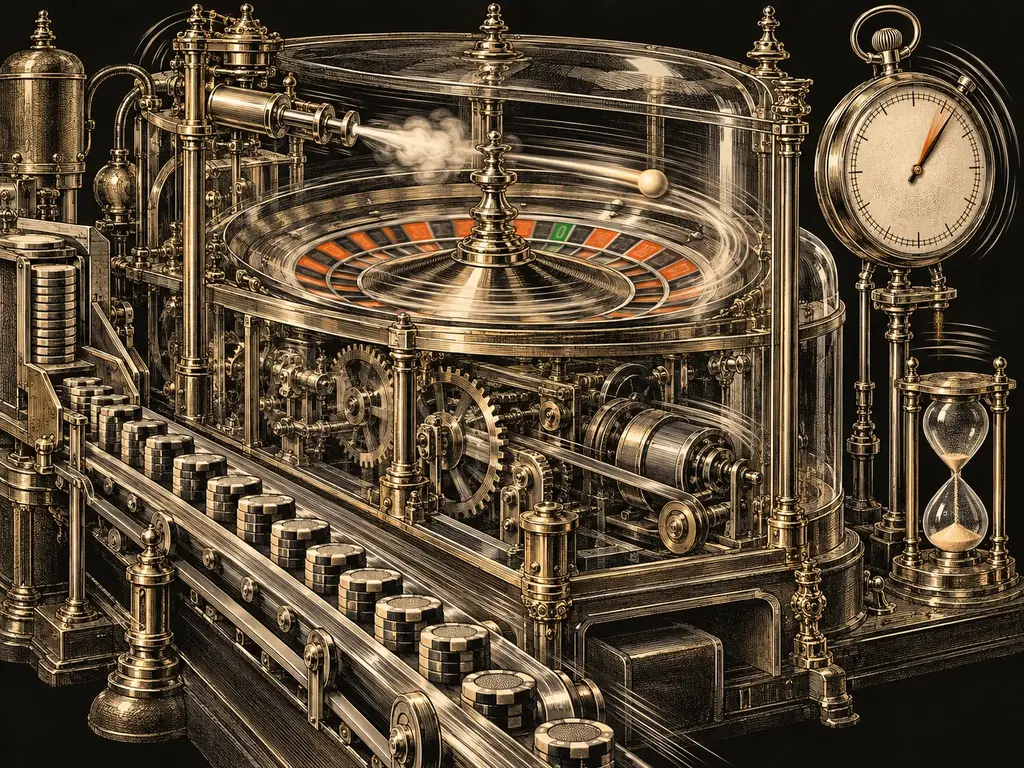
Speed and auto roulette shorten the betting window to around 15 seconds and skip the dealer chat. Odds are standard European; expected loss per hour roughly doubles compared with a classic live table at the same stake.
Speed live
A dealer, a wheel, a 12–15 second betting windowliveBetting windowThe period in a live round during which bets are accepted, timed by the game server and shown as a countdown.Read full → and a ballequipmentBallThe small ball launched along the track against the rotor. Modern balls are ivorine or Teflon, 18–21 mm.Read full → launched the instant the previous round settles. No chat, no pause. Round length 30 to 40 seconds; 90 to 110 spins an hour. The odds are European; the bets are the same; the only change is the clock.
Auto roulette
A compressed-air wheel with no dealer, running continuously. The ball is launched by a mechanism; a sensor reads the result. Spins per hour can exceed 100, sometimes 130. Some auto wheels are physical and filmed; some are RNG with a wheel animation. The help panel says which.
Expected loss per hour
stake × spins per hour / 37. At $10: about $11 an hour on a slow floor table, $16 on a standard live table, $24 on a speed table, $54 on an RNG table played at 200 spins an hour. The stake and the odds are identical in every case; only the clock differs.
Cost per hour
Expected lossmathExpected lossExpected value times total amount wagered; the average amount lost over a session or a period.Read full → = stake × spins / 37. At $10 and 100 spins an hour that is $27 per hour, against about $14 on a 50-spin table. The player who moves from a classic table to a speed table at the same stake has doubled the price of the evening with no change in the odds. Halve the stake and the cost is back where it was.
Who it suits
Players who want many results quickly and are sizing the stake accordingly. Not players running a negative progressionstrategyProgressionAny rule that changes the stake based on previous results. Negative progressions raise it after losses, positive after wins.Read full →, who are now hitting the losing run that breaks it twice as often per hour. Not anyone who thinks of the stake as the price; on a speed table the price is the stake times two.
Pace as a budget tool
Because expected loss is linear in spins, the easiest way to halve the cost of an evening is to play half as many spins: a slower table, a longer break between bets, or sitting out spins. None of this changes the odds and all of it changes the bill. A player who sits out every other spin on a speed table has turned it into a standard table at no cost.
Pace and systems
Progressions are often sold with the advice to play fast “to get through the losing runs”. Playing fast gets you through everything faster, including your bankrollmoneyBankrollThe total amount set aside for play. Bankroll management is deciding how much of it to risk per bet and per session.Read full →, and increases the number of attempts per hour at the losing run that breaks the system. Speed is the enemy of every negative progression, in exact proportion to the stake.
Measuring it
Count rounds for ten minutes and multiply by six. Live tables publish round times in their help panels. The Demo Game on this site runs at any speed you like, including instant batches, which is a useful way to feel how fast 2.70% adds up at 1,000 spins.
Questions
No. The pace is fixed by the format and the server.
Some are physical wheels with a mechanical launcher; some are RNG. The help panel states it.
Yes. Every spin you skip is a spin you do not pay 2.70% on.
No. Identical odds, more spins per hour.
Live, because the server limits the pace. RNG is cheapest per spin in minimums and dearest per hour at any given stake.
Several hundred. The dealer’s pace, not yours, sets the table’s rhythm.
Comic relief
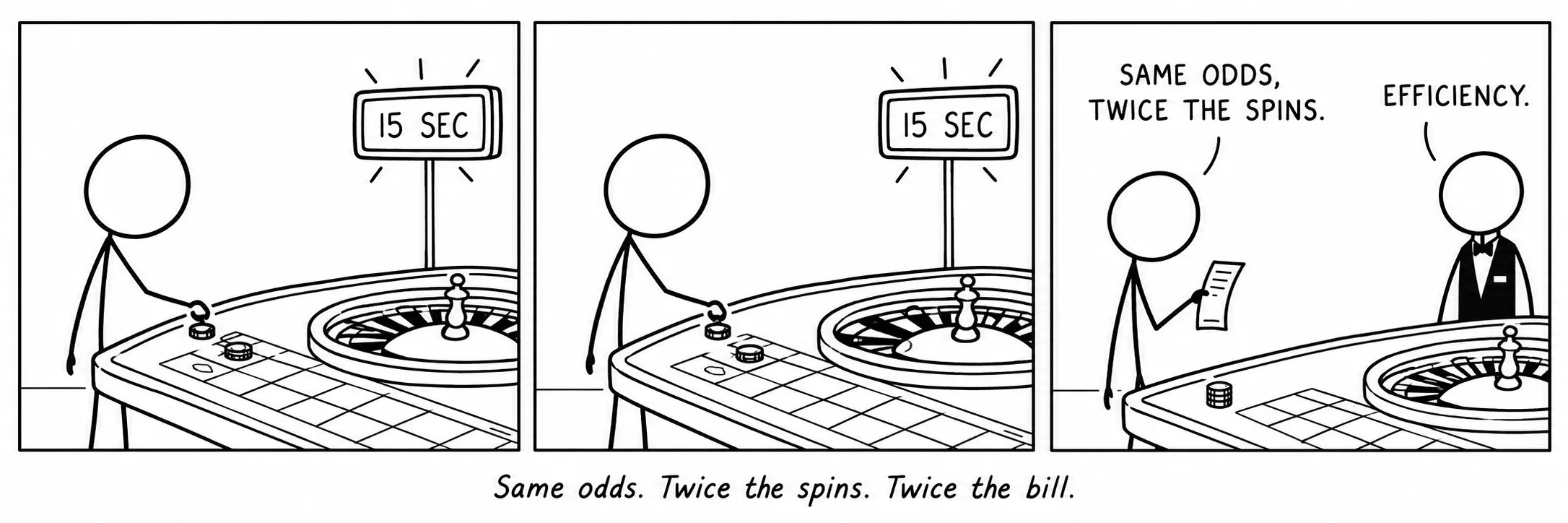
Same odds. Twice the spins. Twice the bill.
Sources
- UK Gambling Commission. Remote gambling and software technical standards.