Richard Jarecki
A doctor, a month of note-taking per wheel, and a computer story that kept the casinos guessing.
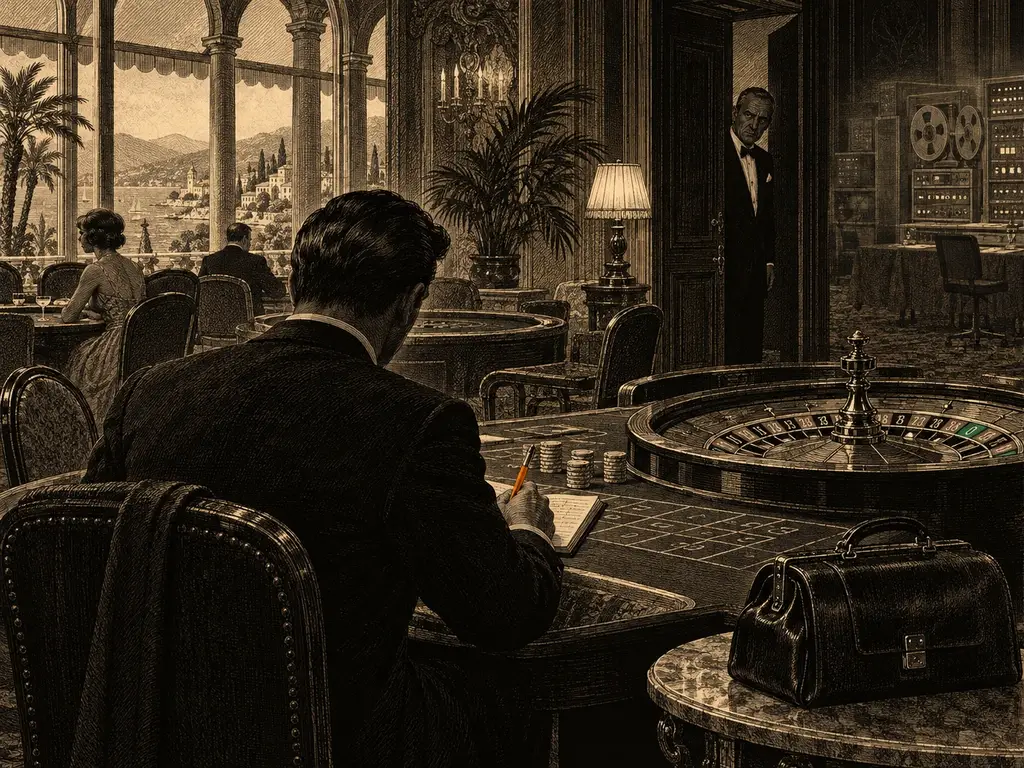
Richard Jarecki (1931–2018), a German-born American doctor, recorded roulette wheels in European casinos in the 1960s and early 1970s and bet the numbers that came up too often. By many accounts he won more than $1.2 million; nobody ever audited the figure. He told reporters that a computer in London did the work, which the New York Times and the roulette historian Russell Barnhart describe as a cover.
A doctor from Stettin
Richard Wilhelm Jarecki was born on 1 December 1931 in Stettin, then in Germany and now Szczecin in Poland. His father was a dermatologist and his mother’s family owned a shipping company. The family was Jewish and left Germany in the late 1930s. He grew up in Asbury Park, New Jersey, studied at Duke University, and went back to Germany for his medical degree, which he took at Heidelberg in 1958. He married Carol Fuhse, a nurse trained in anesthesia, in 1964. In 1967 the couple moved to Heidelberg, where he did research in forensic medicine at the university. His own description of the post in 1969 was associate researcher, although the newspapers made him a professor.
The method
The account comes from Carol Jarecki, who gave it to the New York Times in 2018. The two of them and a handful of helpers wrote down the result of every spin of a chosen wheel, looking for numbers that won more often than they should because of a small fault of manufacture or wear. One wheel could take more than 10,000 spins and as long as a month, and some wheels showed nothing worth betting. She did not claim it as new: “It isn’t something he invented. It’s something he perfected.”
They played in dozens of casinos, among them Monte Carlo, Divonne-les-Bains, Baden-Baden and Sanremo, where he became a regular. Europe suited him because its wheels have one zerowheelZeroThe single green pocket that no even-money, dozen or column bet covers; the source of the house edge. Also: single zero, 0.Read full →, 37 pocketsequipmentPocketOne of the 37 numbered compartments on the rotor. Also: slot, cup.Read full → against 38. A croupierpeopleCroupierThe dealer at a roulette table.Read full → at Sanremo told the Trieste newspaper Il Piccolo in February 1969 that he never played alone: he ran five or six tables at once, with about ten people placing the bets and reporting the numbers.
He also learned to know one wheel from another. Staff at Sanremo said that one evening they moved every table; he stood for a long time, puzzled, and then went to exactly the tables he had been playing. Carol Jarecki’s explanation is that he had memorized the nicks and scratches.
Why ten thousand spins
In 10,000 spins of a fair single-zero wheel each number comes up about 270 times, give or take 16. A number seen 319 times is three of those “give or takes” ahead, and luck almost never does that. It wins once in about 31 spins, and at 35 to 1 a bet on it earns 15%.
Now take 1,000 spins. A fair number comes up about 27 times, give or take 5, and with 37 numbers on the wheel the luckiest of them will usually have 37 hits or more. That looks like a hot numbermythHot numberA number that has appeared more often than expected recently. On a fair wheel it predicts nothing.Read full → and means nothing. The month of note-taking is the price of telling a faulty pocket from a lucky one. See Sample Size.
What is not known
No source says which numbers he bet, how many of them, how much he staked or how large his advantage was. Barnhart, who wrote the one book chapter on him, puts the fault at Sanremo down to wheels with low separators between the pockets; the basis for that is not given. Where his stake money came from is not documented either. Asked in 1969, he said he played on his winnings.
The computer story
Jarecki told reporters that the work was done by a computer at the University of London, to which he telephoned the day’s numbers each night; Barnhart identifies the machine as an Atlas run by friends of his. The New York Times obituary says plainly that there was no electronic help, only observation, and Barnhart calls the computer explanation a fiction that fooled casino managers, the gaming police and the public.
His own statements shifted. In February 1969 he told Il Piccolo that he had used a computer for a while, only to save arithmetic, and that a computer does not think or invent. In May 1969 he gave the Sydney Morning Herald a system built on the last three numbers to come up, which is not how a biased wheellabBiased wheelA wheel whose physical defects make some pockets more likely than 1/37. Rare, detectable only with thousands of recorded spins.Read full → is played at all. By then Sanremo was already putting the simpler explanation to him: that he won because he knew how worn its wheels were. He denied it.
Sanremo, winter 1969
The best-documented weeks of his career are these. The town controlled the casino, so the town council had the last word.
The casino asks him to stay away for fifteen days. The reason given to the press is the crowd round his table. He says he was told to wait until the roulette wheels had been changed.
The town council bars him as a professional gambler and withdraws his admission card.
His lawyers argue that a professor of forensic medicine can hardly be a professional gambler. The council lifts the ban and promises him an honor card with free entry.
Readmitted after a second exclusion, according to an Italian news agency report quoted by Barnhart.
He returns to the United States.
What the managers said
His own line on the ban has lasted best: “If casino managers don’t like to lose, they should sell vegetables.” The Sydney Morning Herald quoted Robert Lardera, whom it called the casino’s managing director, saying that he was “a menace to every casino in Europe”. Other sources name the manager at the time as Luigi Bartolini, who is quoted calling Jarecki a very nice man with a clear mind and strong nerves. Jarecki said in 1969 that several casinos had asked him privately not to come back, and that none had ordered him out. Carol Jarecki said much later that outright bans were rare, because he made friends with the staff.
How much he won
Every figure is a claim, and they do not agree.
What the casinos changed
Sanremo moved its tables about, which did not stop him. According to the Times it then replaced some two dozen wheels, and that did. The obituary adds that wheels in general came to be made more carefully, with fewer faults to find, and that his advantage faded. No source shows a casino ordering better wheels because of him, and no wheel maker is named.
After roulette
Back in the United States he traded commodity futures on his own account, mostly silver and gold, and went on playing roulette and blackjack in Las Vegas and Atlantic City. About 1998 he moved to Manila, whose casinos he preferred. He died there on 25 July 2018, aged 86. By his wife’s account he had last played the previous December, in a tournament in Manila, and came first.
Questions
He said so at the time. The New York Times obituary and Barnhart’s book both say the computer was a cover for recording spins by hand.
Sanremo asked him to stay away in January 1969, barred him in February and readmitted him within days. Elsewhere he was mostly asked, privately, not to return.
More than $1.2 million by many accounts. The figure comes from press reports and unnamed casino sources and was never audited.
Comic relief
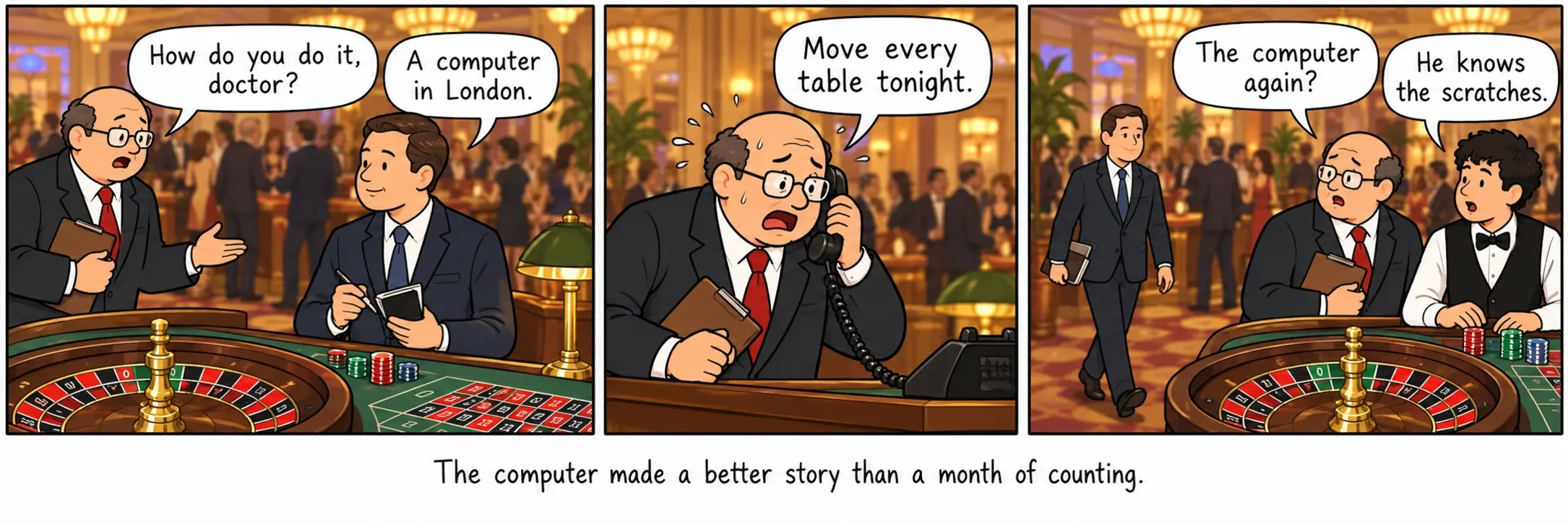
The computer made a better story than a month of counting.
Sources
- Slotnik, D. E. “Richard Jarecki, Doctor Who Conquered Roulette, Dies at 86.”
- McClain, D. L. “Carol Jarecki, Respected Chess Referee, Dies at 86.”
- Barnhart, R. T. Beating the Wheel.
- Isman, F. “Il professor Richard Jarecki, croce (o delizia?) del Casinò.”
- United Press International. “Casino Conqueror Made to Desist.”
- Associated Press. “Winner Wins Casino Card.”
- Vannozzi, A. Report from Rome on “the gambling professor”.