Probability of Streaks
Long runs of one color are common. They are also meaningless for the next spin.
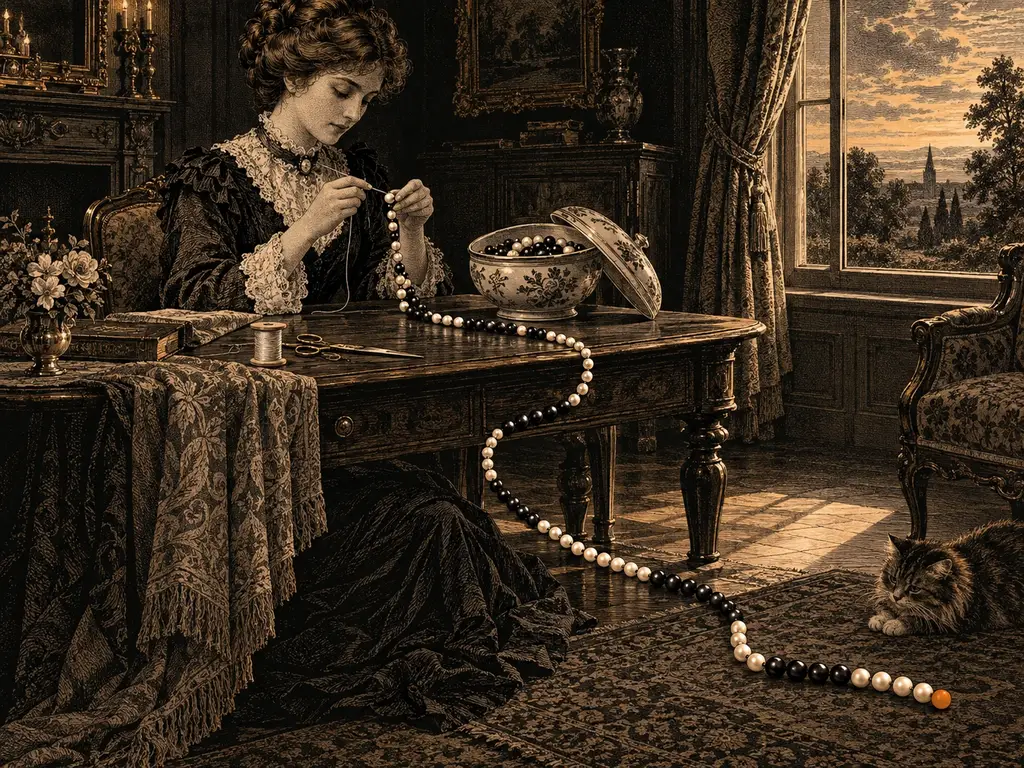
Five reds in a row: 2.7%. Ten: 0.074%. Over a 200-spin session a run of six of one color appears more often than not.
How often a losing streak comes
An even-money bet on a single-zero wheel loses 19 spins in 37. Each row is the chance that a given run of spins all lose, and what a Martingale player, who doubles after every loss, has lost by then.
| losses in a row | chance | about 1 in | lost so far | next bet |
|---|---|---|---|---|
| 1 | 51.4% | 2 | $1 | $2 |
| 2 | 26.4% | 4 | $3 | $4 |
| 3 | 13.5% | 7 | $7 | $8 |
| 4 | 7.0% | 14 | $15 | $16 |
| 5 | 3.6% | 28 | $31 | $32 |
| 6 | 1.8% | 55 | $63 | $64 |
| 7 | 0.94% | 106 | $127 | $128 |
| 8 | 0.48% | 207 | $255 | $256 |
| 9 | 0.25% | 403 | $511 | $512 |
| 10 | 0.13% | 784 | $1,023 | $1,024 |
| 11 | 0.065% | 1527 | $2,047 | $2,048 |
| 12 | 0.034% | 2974 | $4,095 | $4,096 |
| 13 | 0.017% | 5792 | $8,191 | $8,192 |
| 14 | 0.0089% | 11279 | $16,383 | $16,384 |
| 15 | 0.0046% | 21965 | $32,767 | $32,768 |
The chance is 19/37 multiplied by itself once per loss, counted from one given spin. A long session has many spins where such a run can start, so over an evening it is far more likely than one row suggests.
Single run
The probabilitymathProbabilityChance of an outcome, from 0 to 1 or 0% to 100%. One number: 1/37 = 2.70%.Read full → that the next k spins are all redbetRedEven-money bet on the 18 red numbers. French: rouge.Read full → is (18/37)ᵏ. Two: 23.7%. Five: 2.7%. Ten: 0.074%, about 1 in 1,350. Twenty: 1 in 1.8 million. Twenty-six, the Monte Carlo record: 1 in 137 million. These are the odds of a specific run starting at a specific spin, which is the question almost nobody is actually asking.
In a session
The question people mean is “will a run of k appear somewhere in my session?”, and the answer is far larger than (18/37)ᵏ because a 200-spin session offers nearly 200 places for a run to start. A run of six or more of the same color, red or blackbetBlackEven-money bet on the 18 black numbers. French: noir.Read full →, turns up in a 200-spin session about 94% of the time; eight or more about 47%; ten or more about 14%. Name the color in advance and the chances fall, to about 75%, 27% and 7%. A player who sits for an evening will see long streaks every evening.
Why Martingale cares
Every negative progressionstrategyProgressionAny rule that changes the stake based on previous results. Negative progressions raise it after losses, positive after wins.Read full → has a run length that breaks it: six losses from a $10 base at a $500 limit, ten for FibonaccistrategyFibonacciProgression that follows the sequence 1, 1, 2, 3, 5, 8, 13…: one step forward after a loss, two steps back after a win.Read full →, five for tripling on dozensbetDozen1–12, 13–24 or 25–36, pays 2:1.Read full →. The probability of a losing run of six on even money is (19/37)⁶ ≈ 1.8% per attempt, and a 200-spin session contains perhaps 100 attempts, so the break arrives in roughly four sessions out of five of that length. Streak probabilities are the reason the cliff is not rare.
Hot and cold numbers
The same arithmetic applies to straight upsbetStraight upA single number, pays 35:1.Read full →. In 300 spins the expected count per number is 8.1; the standard deviationmathStandard deviationSquare root of variance; the typical distance of a result from the expected value.Read full → is about 2.8. Some number will show 15 hits and some 2 by chance alone, every time. A results board highlighting “hot” numbers is highlighting the top of a normal distribution. The Lab explains how many spins it takes before a hot numbermythHot numberA number that has appeared more often than expected recently. On a fair wheel it predicts nothing.Read full → means anything (thousands, from one identified wheel).
Independence is the whole point
A run of ten reds does not make black more likely, and it does not make red more likely either. Both are 18/37. Streaks are a property of random sequences and would be suspicious by their absence: a sequence of 200 spins with no run longer than four would be far stronger evidence of tampering than one with a run of twelve.
Formula
Questions
26 blacks at Monte Carlo on 18 August 1913 is the famous one. 32 reds in a row was reported in an American casino in 1943. Both are consistent with chance given how many spins casinos run.
It is 18/37 either way. Bet what your plan says, or nothing.
No. Bias shows up as some pocketsequipmentPocketOne of the 37 numbered compartments on the rotor. Also: slot, cup.Read full → hitting more often over thousands of spins, not as runs of a color.
Fun with Math
Try these yourself first. Each solution is folded; open it when you are ready.
How many spins of a European wheel does it take, on average, before every one of the 37 numbers has come up at least once?
Show the solution
Answer About 155 spins on average; the median is 147.
Count the wait one new number at a time. The first spin always shows a new number. Once you have seen 1 number, 36 pocketsequipmentPocketOne of the 37 numbered compartments on the rotor. Also: slot, cup.Read full → in 37 are new, so the next new number takes 37/36 spins on average. Once you have seen k numbers, it takes 37/(37 − k).
Add the waits: 37/37 + 37/36 + 37/35 + … + 37/1 = 37 × (1 + 1/2 + 1/3 + … + 1/37) ≈ 37 × 4.20 = 155.5 spins.
Most of that is the end. The last number alone takes 37 spins on average, and the last five about 85. On an American wheel the same sum gives about 161. This is the coupon collector’s problem; the Wizard of Odds gives the same mean.
In 37 spins of a European wheel, one spin for each pocket, how many different numbers should you expect to see?
Show the solution
Answer About 23.6. Roughly a third of the numbers, about 13, do not come up at all.
Take one number, say 17. On each spin it fails to come up with chance 36/37, so it misses all 37 spins with chance (36/37)³⁷ ≈ 0.363.
Every number has the same chance, so on average 37 × 0.363 ≈ 13.4 numbers are missing and 37 − 13.4 ≈ 23.6 come up, many of them twice or more.
Roulette players call this the law of thirds. It is no law, only the arithmetic of repeats: in a run as long as the wheel, about a third of the numbers sit out, on a fair wheel as on any other. On 38 pockets the share is (37/38)³⁸ ≈ 0.363 too; for a large wheel it settles near 1/e ≈ 0.368.
A friend shows you two lists of 50 colors, redbetRedEven-money bet on the 18 red numbers. French: rouge.Read full → or blackbetBlackEven-money bet on the 18 black numbers. French: noir.Read full →, each said to come from a wheel with the zeroswheelZeroThe single green pocket that no even-money, dozen or column bet covers; the source of the house edge. Also: single zero, 0.Read full → left out. One switches color 25 times and its longest run is six. The other switches 35 times and never runs past three. Which one was made up?
Show the solution
Answer The second. A real list switches about 24 or 25 times. One with 35 switches turns up about once in 500 lists, and one with no run longer than three about twice in 100.
Each new color either repeats the last one or switches, half and half, so 49 chances to switch give 24.5 switches on average, give or take about 3.5. Thirty-five is three of those steps above the average; a fair wheel produces that many switches about once in 500 lists.
The runs tell the same story. A real list of 50 has a run of four or more about 98% of the time, and its longest run is most often five or six.
People asked to invent a random list switch too often, because a run of four or five looks to them like a pattern. Taylor (2021) shows the same tell in lists of coin tosses made up by students: real randomness is streakier than people expect.
A book of casino stories tells of a player whose number came up five times in a row and calls it a record. How rare is that on a European wheel? And how often should it happen somewhere in one casino with 20 tables, each spinning 40 times an hour, day and night?
Show the solution
Answer A named number five times running: 1 in 69 million. Any number coming up four more times after it first appears: 1 in 1.87 million. That casino spins about 7 million times a year, so it should see a run of five three or four times a year.
A named number comes up with chance 1/37 each spin, so five in a row has chance (1/37)⁵ = 1 in 69,343,957. But nobody names the number in advance. Whatever comes up first, the next four spins must repeat it: (1/37)⁴ = 1 in 1,874,161.
20 tables × 40 spins × 24 hours × 365 days = 7,008,000 spins a year. Each spin can start a run, so the casino expects 7,008,000/1,874,161 ≈ 3.7 runs of five a year.
No official record of this kind exists, and none is needed: a rare event at one table is a routine one across a casino, and the stories are told about the table where it happened. The story, in Goldman (2007), is set on a double-zero wheel, where the figures are 1 in 79 million and 1 in 2.09 million.
Comic relief
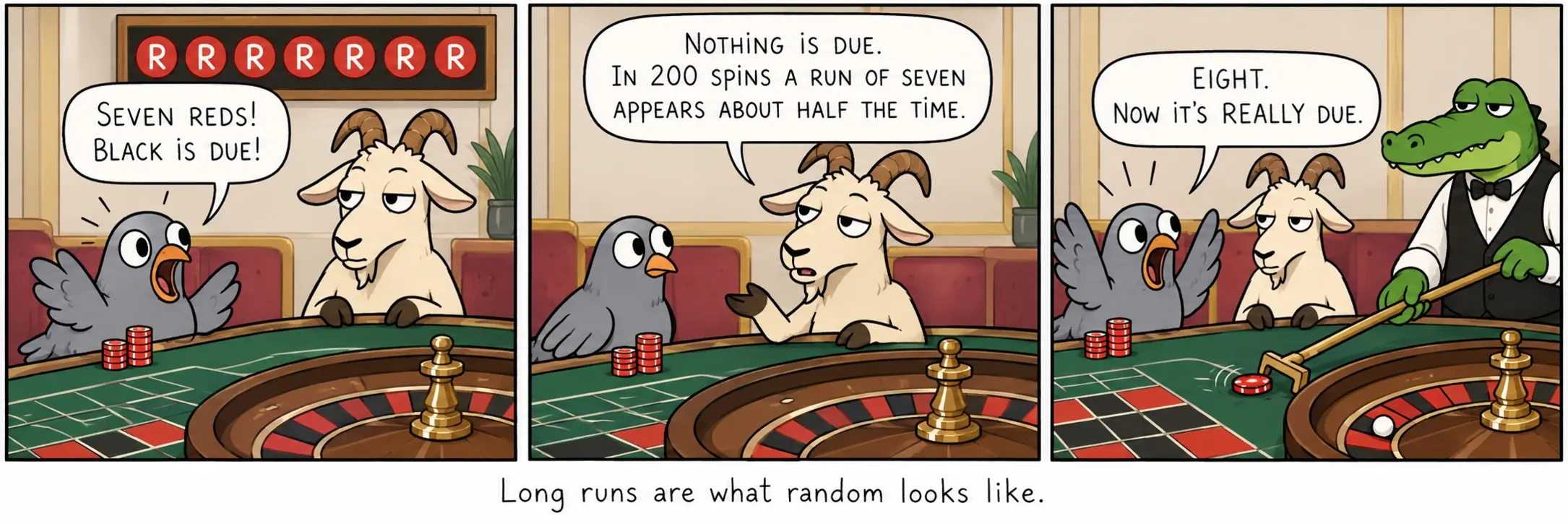
Long runs are what random looks like.
Sources
- Feller, W. An Introduction to Probability Theory and Its Applications, Vol. 1.
- Ethier, S. N. The Doctrine of Chances: Probabilistic Aspects of Gambling.
- Taylor, D. G. Games, Gambling, and Probability: An Introduction to Mathematics, 2nd ed.