Dozens / Columns
Betting two dozens or two columns at once covers 24 of 37 numbers.

Win 64.9% of spins for a net of +1 unit; lose 2 units the other 35.1%. Expected valuemathExpected valueThe average result per bet over the long run. −1/37 of the stake for every standard European bet.Read full →: −2.70% of the two units staked.
The arithmetic
One unitmoneyUnitThe base stake a system or a player works in. Progressions are described in units so they apply at any table.Read full → on each of two dozensbetDozen1–12, 13–24 or 25–36, pays 2:1.Read full →. A hit in either pays 2 and loses the other: +1. A miss (the third dozen or zerowheelZeroThe single green pocket that no even-money, dozen or column bet covers; the source of the house edge. Also: single zero, 0.Read full →) loses both: −2. (24 × 1 − 13 × 2)/37 = (24 − 26)/37 = −2/37 per two units staked = −1/37 per unit. Same edge as everything else, different shape: nearly two wins in three, each worth half a losing spin.
Why it feels like winning
Winning 65% of spins is the highest hit rate available with ordinary bets short of the 25-number James Bond spread. A session of two-dozen betting is a long gentle sawtooth: up one, up one, down two, up one. The mean slope is −2.70% of turnovermoneyTurnoverThe total amount wagered over a session or period, counting re-bet winnings. Also: handle, action.Read full →, and because you stake two units per spin, turnover is doubled relative to a single dozen.
- p10 −$500
- p25 −$500
- median −$360
- p75 +$0
- p90 +$280
Progressions on dozens
Doubling the stake after a loss does not recover on a 2 to 1 bet the way it does on even money. Suppose you lose 2 units (one on each dozen), double to 2 and 2, and win: you collect 4 and lose 2 on the other dozen, net +2, which only covers the previous loss with nothing over. To net +1 after each loss you must more than double, and the standard dozens progressionstrategyProgressionAny rule that changes the stake based on previous results. Negative progressions raise it after losses, positive after wins.Read full → is to triple: 1, 3, 9, 27, 81. A $500 limit from a $5 base is hit after five losses; (13/37)⁵ ≈ 0.5% per attempt, with many attempts per session.
Rotation and “sleeping” dozens
Many sold systems rotate which dozen to leave out, usually the one that hit most recently or the one that has not hit for a while. Spins are independent, so the choice of which 13 numbers to leave uncovered has no effect on anything. The systems are equivalent to each other and to picking the uncovered dozen at random.
Columns
Everything above applies to two columnsbetColumnTwelve numbers in one vertical column of the layout, pays 2:1.Read full →, which also cover 24 numbers, or to a dozen plus a column, which cover 20 (four numbers double-counted). The Bet Builder tool gives the exact distribution for any mix.
A slower doubling
A pamphlet sold in Las Vegas, Famous Las Vegas Gambling Systems, offers a gentler progression for a column: bet 1 unit, bet 1 again after a loss, and double only after two losses in a row, so the stakes run 1, 1, 2, 2, 4, 4, 8, 8 (Bollman, 2024). The stakes grow half as fast as a MartingalestrategyMartingaleProgression that doubles the bet after each loss. See the Strategy section for what it does and does not do.Read full →’s, and the price is that a win no longer always covers the losses: a win on the second bet of a pair can leave you level or behind. Ten misses in a row cost 62 units and come about once in 50 tries, since a column misses 25 times in 37. Every unit staked still costs 2.70%.
Questions
Higher hit rate, bigger losses, same expected value. RedbetRedEven-money bet on the 18 red numbers. French: rouge.Read full → at the same total stake has lower variancemathVarianceA measure of how widely results spread around the expected value. High for straight up, low for even-money bets.Read full →.
Add a chipmoneyChipA token representing a fixed amount, placed on the layout to make a bet. Also: check.Read full → on zero and you cover 25 numbers; zero then pays 35 − 2 = +33 instead of −2. The expected value becomes −3/37 per three units: unchanged per unit.
Fun with Math
Try these yourself first. Each solution is folded; open it when you are ready.
The pamphlet’s columnbetColumnTwelve numbers in one vertical column of the layout, pays 2:1.Read full → system stakes 1, 1, 2, 2, 4, 4, 8, 8 unitsmoneyUnitThe base stake a system or a player works in. Progressions are described in units so they apply at any table.Read full →, doubling only after two losses in a row, and stops at the first win. A column pays 2 to 1. How far ahead or behind are you if the first win comes on bet 1, 2, 3 … 8?
Show the solution
Answer A win on bet 1, 3, 5 or 7 leaves you 2 units up. A win on bet 2, 4, 6 or 8 leaves you +1, 0, −2 and −6 units: short of the usual +2, and behind from bet 6 on.
A win at stake s pays 2s; subtract everything lost before it.
Bet 1 (stake 1): +2. Bet 2 (stake 1, 1 lost before): 2 − 1 = +1. Bet 3 (stake 2, 2 lost): 4 − 2 = +2. Bet 4 (stake 2, 4 lost): 4 − 4 = 0. Bet 5 (stake 4, 6 lost): 8 − 6 = +2. Bet 6 (stake 4, 10 lost): 8 − 10 = −2. Bet 7 (stake 8, 14 lost): 16 − 14 = +2. Bet 8 (stake 8, 22 lost): 16 − 22 = −6.
The first stake of each pair always nets +2; the second nets +1, 0, −2, −6, −14 and so on, worse each time. That is the price of the slower climb. A column misses 25 times in 37, so ten misses in a row, 62 units lost, come about once in 50 tries.
Comic relief
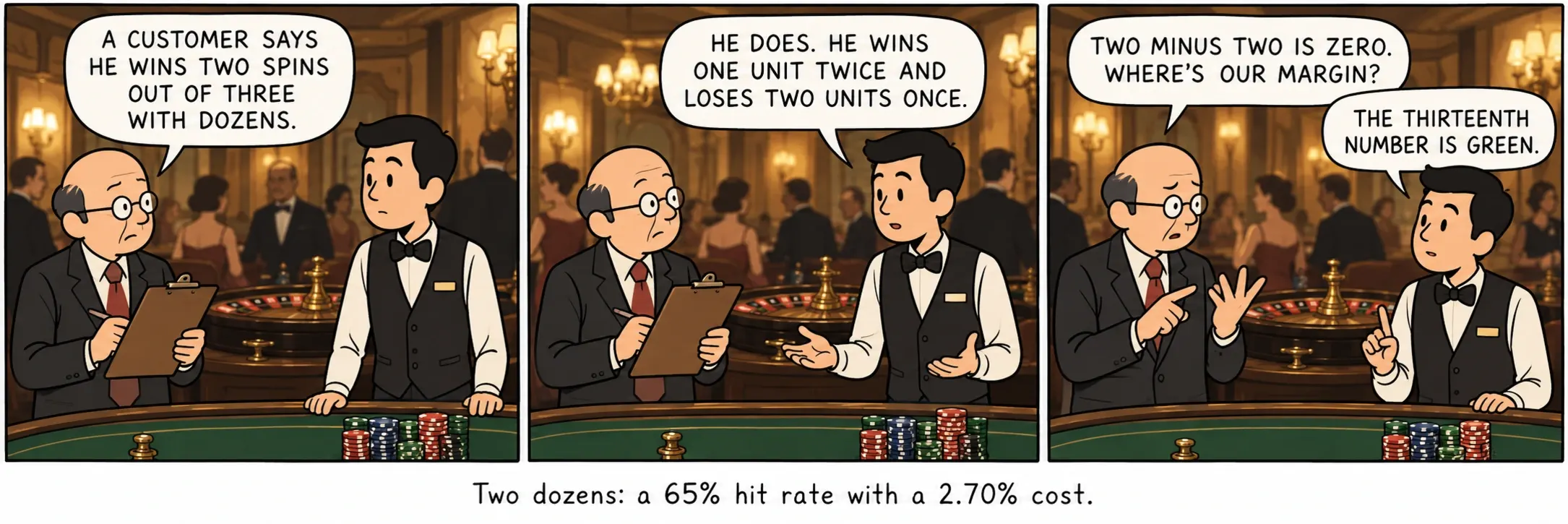
Two dozens: a 65% hit rate with a 2.70% cost.
Sources
- Ethier, S. N. The Doctrine of Chances: Probabilistic Aspects of Gambling.
- Bollman, M. Basic Gambling Mathematics: The Numbers Behind the Neon, 2nd ed.