How to Detect Wheel Bias
Record, count, test, then record more.
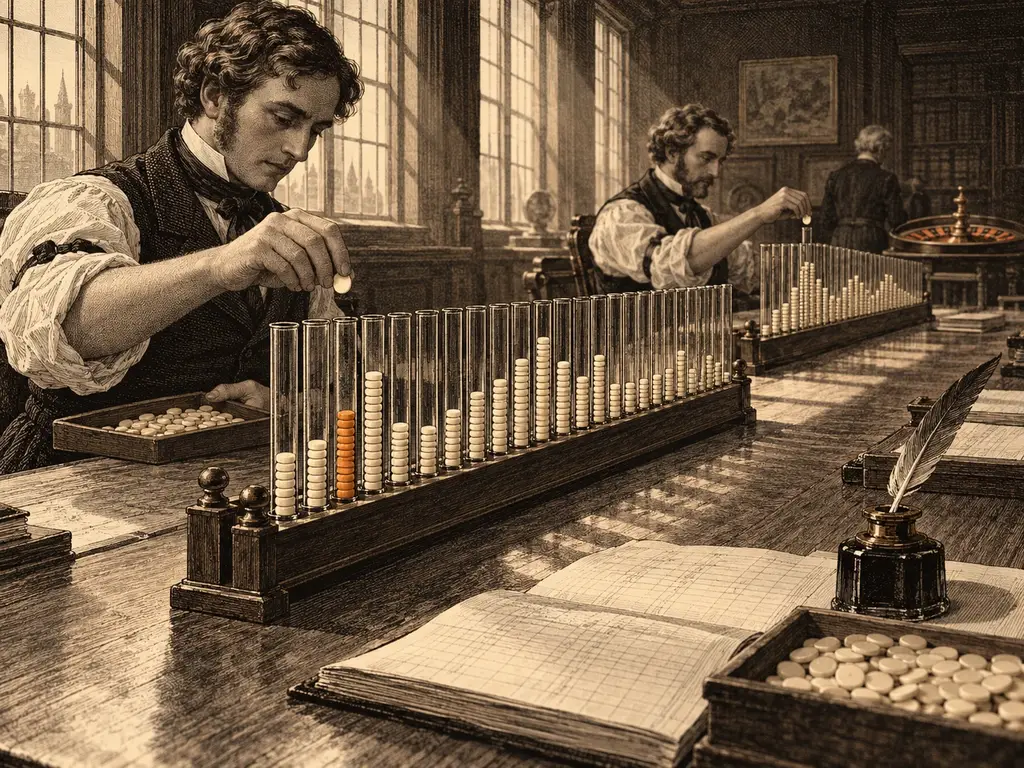
Collect at least a thousand spins from one wheel, count hits per pocket, run a chi-square testlabChi-square testStatistical test comparing observed hits per pocket with the expected n/37. Used to judge whether a wheel is biased.Read full →, and treat any single significant result as a reason to collect a second independent sample.
1. Record
Spin histories from live tables are often published or displayed and can be copied. Note the wheel identity: tables rotate wheel headsequipmentWheel headSynonym for rotor: the spinning part carrying the numbers.Read full → between bowlsequipmentBowlThe fixed outer part of the wheel: the wooden or composite rim that holds the ball track and apron, inside which the rotor spins.Read full →, and a bias belongs to a wheel, not to a table or a dealer. Record the date and time; a wheel that is biased today may be re-fretted tomorrow. A thousand spins is the minimum for the test to say anything; ten thousand is where it starts to be useful.
2. Count and test
Count hits per pocketequipmentPocketOne of the 37 numbered compartments on the rotor. Also: slot, cup.Read full →. Expected is n/37 each. Compute the chi-square statistic, Σ (observed − expected)² / expected, over the 37 pockets and compare it with the chi-square distribution on 36 degrees of freedomlabDegrees of freedomThe number of independent values in a statistic. For a chi-square test on 37 pockets it is 36, because the counts must add up to the total.Read full →. The Wheel Bias Analyzer on this site does it in the browser. Look also at sectorswheelSectorA contiguous arc of pockets on the wheel, as distinct from a group on the layout.Read full →: a physical defect usually affects neighboring pockets together, and a sector test has fewer chances to throw a false positive than 37 individual pocket tests.
3. Replicate
Split the data into halves, or gather a fresh sample of the same size from the same wheel. A bias that is real appears in both samples; a fluke does not. A chi-square significant at 5% in one sample is expected one time in twenty from a fair wheel, and a player who scans many wheels will find such samples routinely. Only after replication is it worth computing whether the hot pockets pay enough to beat 2.70%.
4. Size the effect
Significance says the wheel is probably not fair. Profitability needs a pocket to hit at 1/36 or better, since a straight upbetStraight upA single number, pays 35:1.Read full → pays 35 to 1. A pocket observed at 40 hits in 1,000 is 1/25, which would be hugely profitable if real, and would also be a 2.5-sigma event under fairness; a second sample of 1,000 would be expected to show it again at 40 ± 6 if the bias is real and at 27 ± 5 if it was noise.
What then
Historically: bet the hot sector, win until the casino notices, and be banned or watch the wheel disappear. The García-Pelayo family did this near Madrid in the early 1990s, and when the casino barred them the Spanish courts overturned the ban. Casinos now rotate rotorsequipmentRotorThe spinning part of the wheel that carries the pockets.Read full → between bowls and measure pockets on a schedule; a bias large enough to see in a thousand spins would not survive a maintenance cycle. The method is sound and the opportunity is, in practice, gone.
The busiest pocket is always busy
Picking out the busiest pocket and testing it alone is a trap, because a fair wheel always has a busiest pocket. After 3,700 spins every pocket expects 100 hits, yet the busiest one typically shows about 122, and in one sample in twenty it shows 131 or more. The quietest typically shows about 79. So a pocket at 125 in 3,700 spins is no find: compare it with what the busiest pocket of a fair wheel does, not with 100.
Common mistakes
Pooling spins from different wheels or different wheel heads. Testing after seeing the data and choosing the grouping that looks worst. Treating a hot numbermythHot numberA number that has appeared more often than expected recently. On a fair wheel it predicts nothing.Read full → in 200 spins as a signal. Forgetting that the test assumes independence, so a dealer-signature effect would also inflate chi-square without any pocket being physically favored.
Questions
1,000 to run the test at all; several thousand to detect a bias worth having; tens of thousands to confirm one.
Only if it identifies the wheel and shows enough spins. Most boards show 20 to 500, which is not enough.
That the wheel is probably not producing uniform results. Not that any pocket pays enough, and not that the pattern will persist.
Fun with Math
Try these yourself first. Each solution is folded; open it when you are ready.
On a worn wheel three redbetRedEven-money bet on the 18 red numbers. French: rouge.Read full → pocketsequipmentPocketOne of the 37 numbered compartments on the rotor. Also: slot, cup.Read full → are slightly shallow, and a ballequipmentBallThe small ball launched along the track against the rotor. Modern balls are ivorine or Teflon, 18–21 mm.Read full → that would have stopped in them rolls on into the blackbetBlackEven-money bet on the 18 black numbers. French: noir.Read full → pockets beside them, so red comes up 15 times in 37 and black 21. What do bets on red and on black now cost or earn?
Show the solution
Answer Red costs 18.9%; black earns 13.5%.
Red wins 15 times in 37 and loses 22: (15 − 22)/37 = −18.9%. Black wins 21 times and loses 16: (21 − 16)/37 = +13.5%.
A bias cuts both ways. The wheel that hands an edge to the player who has measured it charges seven times the usual price to the player who backs the wrong color. Hunacek (2025) uses a similar example.
Three pockets in 37 is an extreme fault. A real bias is usually a fraction of this, and it takes thousands of spins to tell it apart from luck, as this page shows.
Comic relief
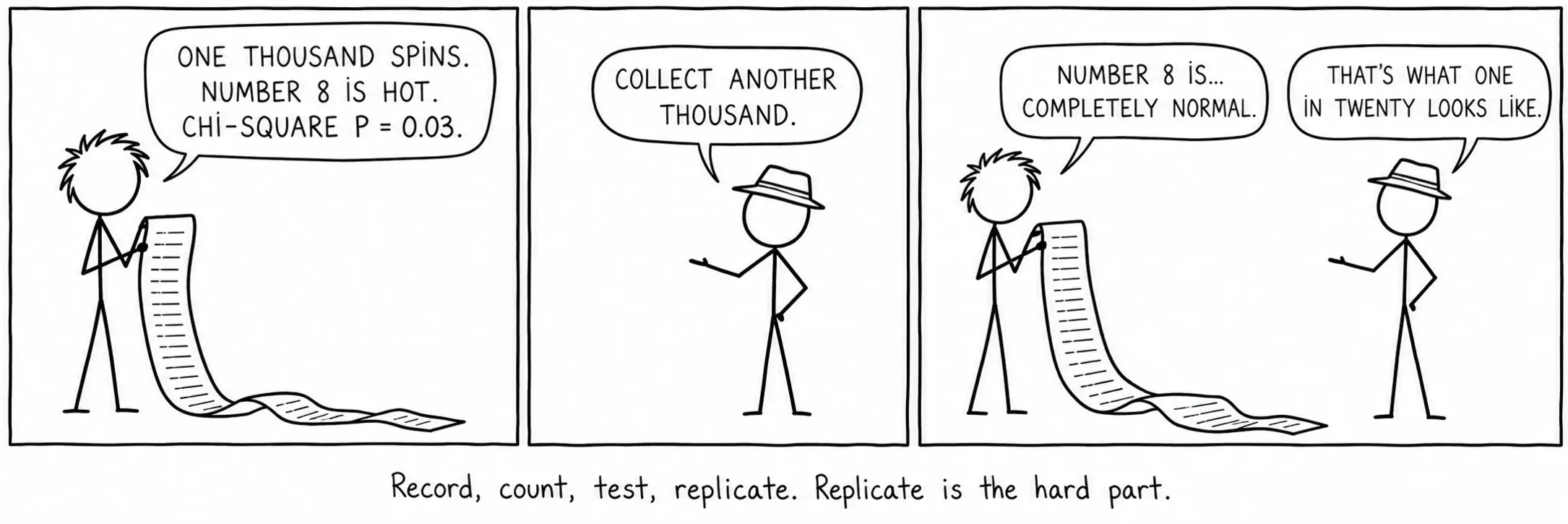
Record, count, test, replicate. Replicate is the hard part.
Sources
- Pearson, K. “On the criterion that a given system of deviations from the probable…”
- Barnhart, R. T. Beating the Wheel.
- Ethier, S. N. The Doctrine of Chances: Probabilistic Aspects of Gambling.
- Wizard of Odds. “Hot Numbers in Roulette: Myths and Facts.”