Reading the Results Board
The electronic board above every wheel shows the past. It knows nothing about the future, and here is what it does show.
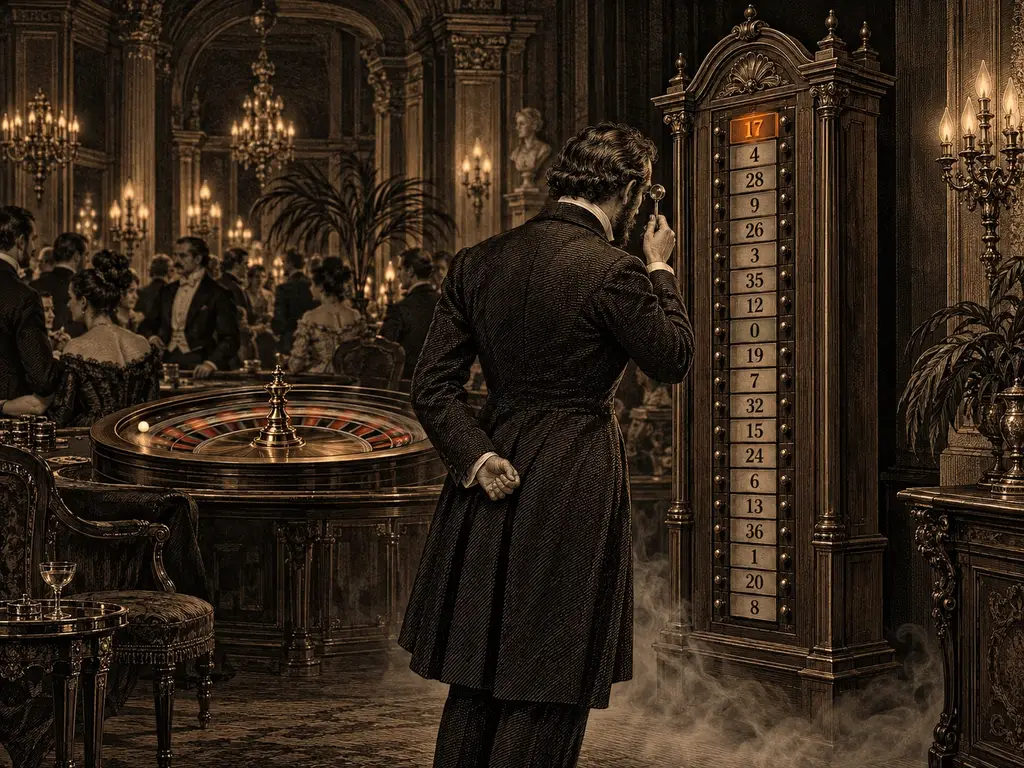
Results boards list recent numbers, color counts, hot and cold numbersmythCold numberA number that has not appeared for many spins. Carries no information about future spins on a fair wheel.Read full → and sometimes sectorwheelSectorA contiguous arc of pockets on the wheel, as distinct from a group on the layout.Read full → statistics. All of it is accurate and none of it predicts the next spin. Learn to read it so you can ignore it on purpose.
What the board shows
The last twenty or so results in order, usually color-coded; the percentage of redbetRedEven-money bet on the 18 red numbers. French: rouge.Read full →, blackbetBlackEven-money bet on the 18 black numbers. French: noir.Read full → and zerowheelZeroThe single green pocket that no even-money, dozen or column bet covers; the source of the house edge. Also: single zero, 0.Read full → in a window; the most and least frequent numbers (“hot” and “cold”); and on live tables a racetracktableRacetrackThe oval strip on live and electronic layouts showing the numbers in wheel order, used to place neighbors and sector bets in one tap.Read full → view with hit counts per pocketequipmentPocketOne of the 37 numbered compartments on the rotor. Also: slot, cup.Read full →. Some boards add streak indicators and “sleepers”, numbers absent for a long time. All of it is a summary of recent spins.
How to read a hot number honestly
In 300 spins the expected count per number is 8.1 with a standard deviationmathStandard deviationSquare root of variance; the typical distance of a result from the expected value.Read full → of 2.8. The hottest of 37 numbers will typically show 13 to 15 hits by chance; the coldest, 2 or 3. A board that highlights a number with 14 hits is highlighting the expected maximum of a fair sample. The Lab’s sample-size page says a real bias of a size worth having needs tens of thousands of spins to show; the board shows hundreds.
When the board is wrong
Boards cost money, about $7,000 each in Bollman’s figures, and one casino found its board paid for itself in extra roulette play within six weeks. They are not infallible. In June 2012 a board at the Rio in Las Vegas showed 19 seven times in a row on a double-zero wheel; a few days later the casino said the display, not the wheel, had failed. Seven 19s in a row on a fair wheel is about 1 in 3 billion, counting from the first 19, and a dollar left riding on 19 through all seven would have grown to over $78 billion, had any table allowed it. Bets are settled from the wheel and the dealer’s call, not from the board.
What the board is for
Players asked for it, so casinos provide it. It also serves a small honest purpose: it lets you check the dealer announced the number you saw, and on live tables it is the record of the round. For a bias hunter it is the first page of a very long notebook; for everyone else it is a screensaver.
Using the board well
Use it to confirm results and to keep your own tally if you are running a stop rule by spins. Do not use it to choose a bet; a fair wheel gives every choice the same expected valuemathExpected valueThe average result per bet over the long run. −1/37 of the stake for every standard European bet.Read full →, and the board cannot tell you whether the wheel is fair. If you find yourself betting a number because it is cold, read the gambler’s fallacy page; if because it is hot, read the same page.
Questions
Because the window is small. Over 100 spins red will be anywhere from 38% to 59% most of the time.
No. It is a display of logged results and is checked against the audit log.
Many live operators publish full histories. That is the raw material for the Wheel Bias Analyzer.
Fun with Math
Try these yourself first. Each solution is folded; open it when you are ready.
Fourteen redsbetRedEven-money bet on the 18 red numbers. French: rouge.Read full → in a row is the kind of run that makes players photograph the board. On a European wheel, what is the chance that the next 14 spins are all red? How many such runs should a casino with 20 tables, each spinning 40 times an hour around the clock, expect in a year?
Show the solution
Answer 1 in 24,044 for the next 14 spins. About 150 runs of 14 or more reds a year, and about 300 counting blackbetBlackEven-money bet on the 18 black numbers. French: noir.Read full → runs too: close to one a day.
Fourteen reds in a row: (18/37)¹⁴ = 1 in 24,044. On a double-zerowheelZeroThe single green pocket that no even-money, dozen or column bet covers; the source of the house edge. Also: single zero, 0.Read full → wheel it is (18/38)¹⁴ = 1 in 34,927, the figure Bollman (2024) gives.
A year of spins: 20 × 40 × 24 × 365 = 7,008,000. A new run of reds can only start after a spin that is not red (19 times in 37), so runs of 14 or more begin about 7,008,000 × 19/37 × 1/24,044 ≈ 150 times a year. Runs of black double it to about 300.
Most days, somewhere in that casino, a board shows a run that the people at that table will remember for years. The board makes it visible; it does not make it mean anything.
Comic relief
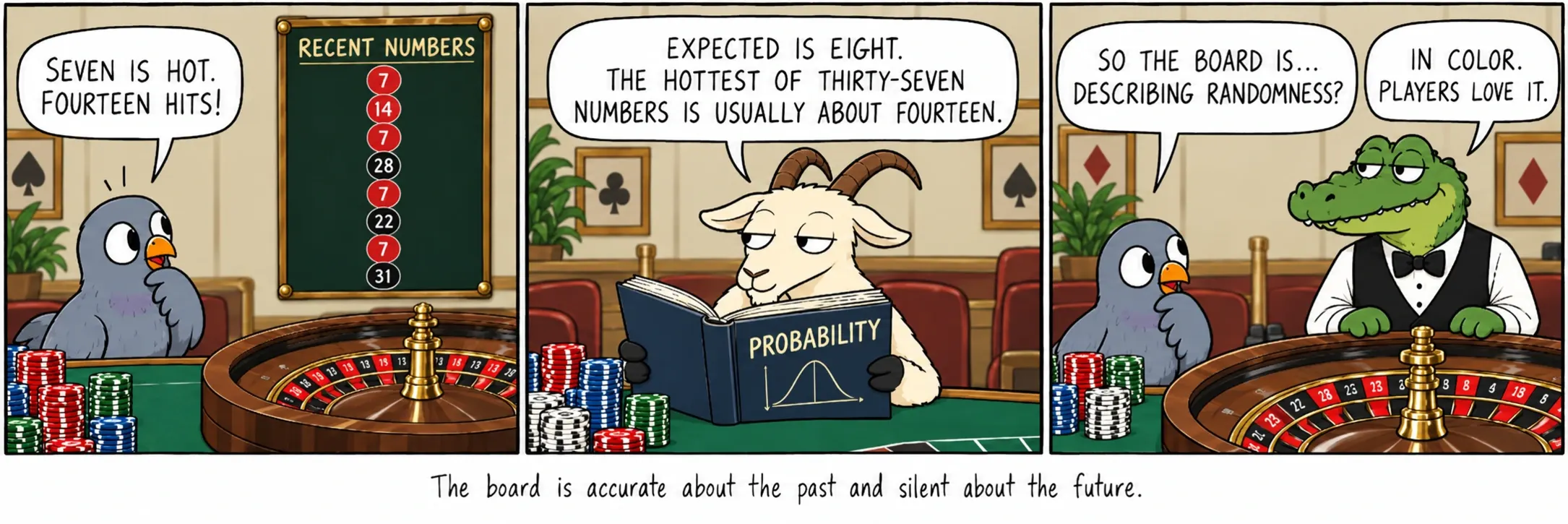
The board is accurate about the past and silent about the future.
Sources
- Feller, W. An Introduction to Probability Theory and Its Applications, Vol. 1.
- Bollman, M. Basic Gambling Mathematics: The Numbers Behind the Neon, 2nd ed.