Neighbors
A number and the two pockets on either side of it on the wheel.
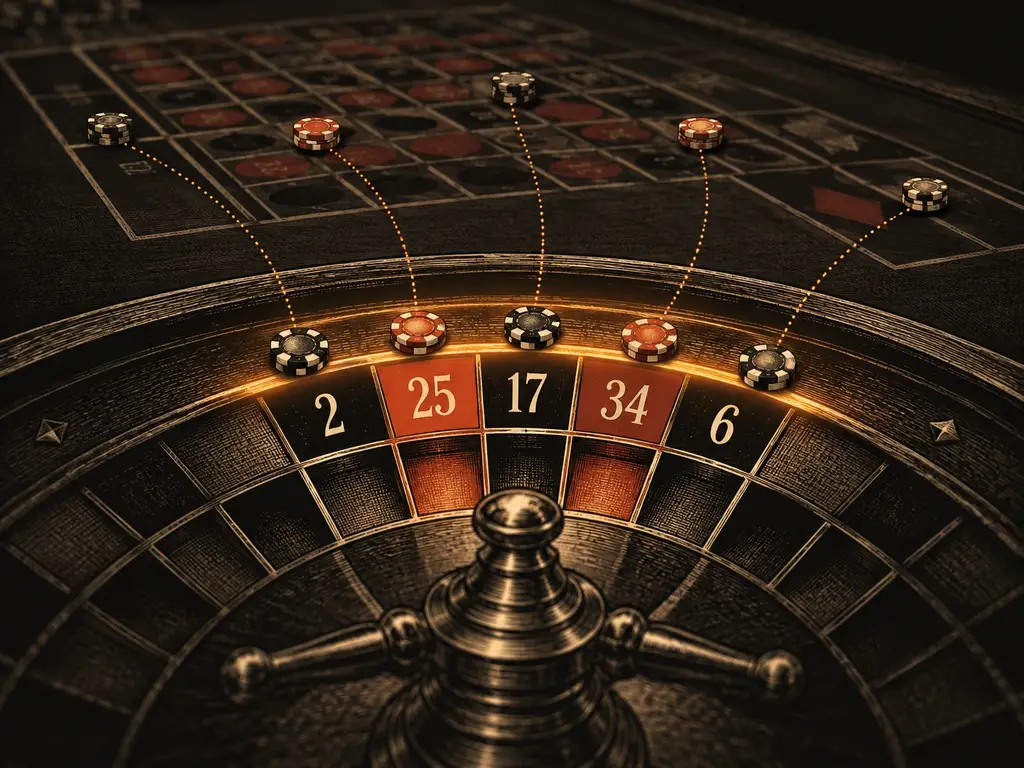
Five straight-up chips on a wheel sector of five. Probability 13.51%; a hit pays 35:1 on one chip, the other four lose, net +31 units.
Pick any number on the wheel. The bet covers it and the two pockets on each side.
Placement
Announced as “17 and the neighborsbetNeighborsA number and the two pockets on either side of it on the wheel, five straight-up chips.Read full →” (dix-sept et les voisins). The dealer places five chipsmoneyChipA token representing a fixed amount, placed on the layout to make a bet. Also: check.Read full →: 17 and the two pocketsequipmentPocketOne of the 37 numbered compartments on the rotor. Also: slot, cup.Read full → on either side of it on the wheel, which are 25 and 2 on one side and 34 and 6 on the other. On a live table the racetracktableRacetrackThe oval strip on live and electronic layouts showing the numbers in wheel order, used to place neighbors and sector bets in one tap.Read full → strip places all five with one tap; some interfaces let you choose one to nine neighbors each side.
Payout and expectation
Any one of the five pockets wins 35 to 1 on its chip while the other four chips lose: net +31 unitsmoneyUnitThe base stake a system or a player works in. Progressions are described in units so they apply at any table.Read full → on a 5-unit stake. ProbabilitymathProbabilityChance of an outcome, from 0 to 1 or 0% to 100%. One number: 1/37 = 2.70%.Read full → 5/37 = 13.51%. Expected valuemathExpected valueThe average result per bet over the long run. −1/37 of the stake for every standard European bet.Read full → per spin: (5/37)(31) − (32/37)(5) = (155 − 160)/37 = −5/37 units, 2.70% of five units. Five straight-up bets, and five straight-up house edgesmathHouse edgeThe share of each stake the casino keeps on average: 2.70% in European roulette.Read full →.
Why it exists
It is the only standard way to bet a physical arc of the wheel. A wheel-bias player who has found a hot sectorwheelSectorA contiguous arc of pockets on the wheel, as distinct from a group on the layout.Read full →, or a dealer-signature believer who thinks the ballequipmentBallThe small ball launched along the track against the rotor. Modern balls are ivorine or Teflon, 18–21 mm.Read full → drops a fixed distance from the launch point, wants exactly this bet. For everyone else it is five straight-ups with a story. The payoutmoneyPayoutWhat a winning bet returns, quoted as “X to 1” on top of the returned stake.Read full → structure is identical to five unrelated numbers.
Wheel order reference
To find anyone’s neighbors use the European sequence: 0 32 15 19 4 21 2 25 17 34 6 27 13 36 11 30 8 23 10 5 24 16 33 1 20 14 31 9 22 18 29 7 28 12 35 3 26, wrapping round from 26 to 0. The neighbors of zerowheelZeroThe single green pocket that no even-money, dozen or column bet covers; the source of the house edge. Also: single zero, 0.Read full → are 26, 3 on one side and 32, 15 on the other. The Wheel Visualizer tool shows any pick on the rim.
Variants
“Neighbors by 1” places three chips; “by 3” places seven. Some casinos accept a single-chip neighbors bet split across five numbers in fractions, paid pro rata. The underlying arithmetic never changes: each chip is a straight upbetStraight upA single number, pays 35:1.Read full → at 35 to 1 against 36 to 1 fair.
Questions
In principle, with the American sequence, but the racetrack is rare on US tables and call betstableCall betA bet announced to the dealer rather than placed by hand, usually a wheel-sector bet such as voisins or tiers. Also “announced bet”.Read full → are uncommon there.
It is the right bet once you have found one. Finding one takes thousands of recorded spins; see the Lab.
Comic relief
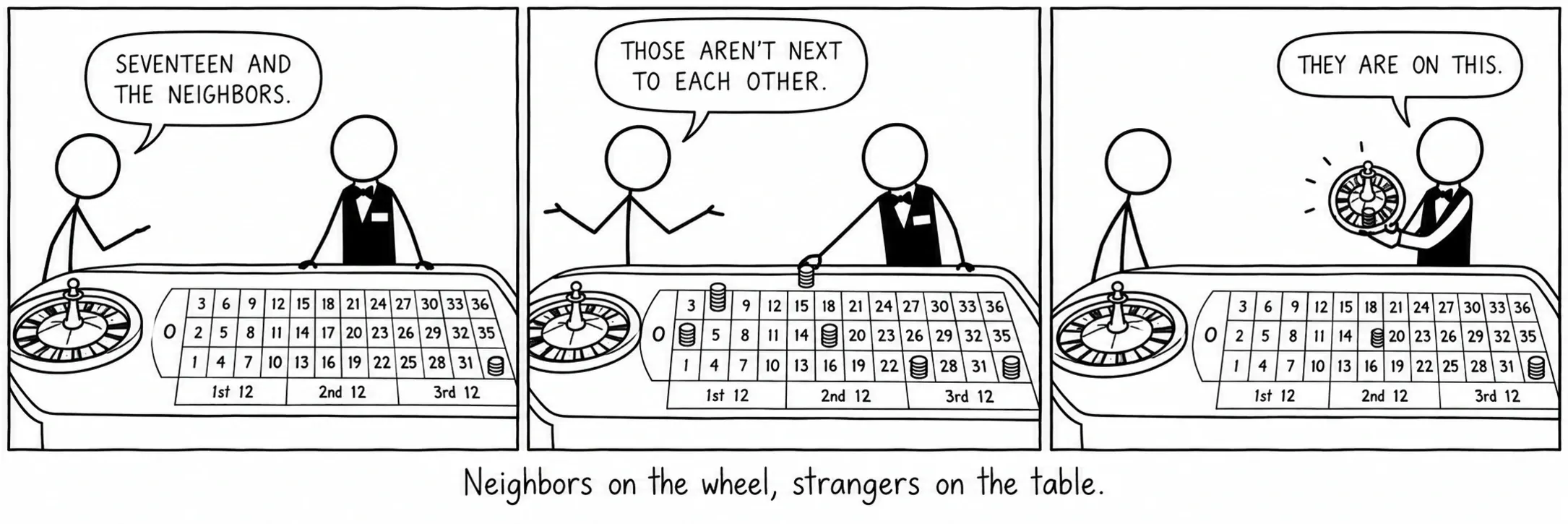
Neighbors on the wheel, strangers on the table.
Sources
- Ethier, S. N. The Doctrine of Chances: Probabilistic Aspects of Gambling.
- Barnhart, R. T. Beating the Wheel.