Advantage Play
What has actually been tried against roulette, and what happened.
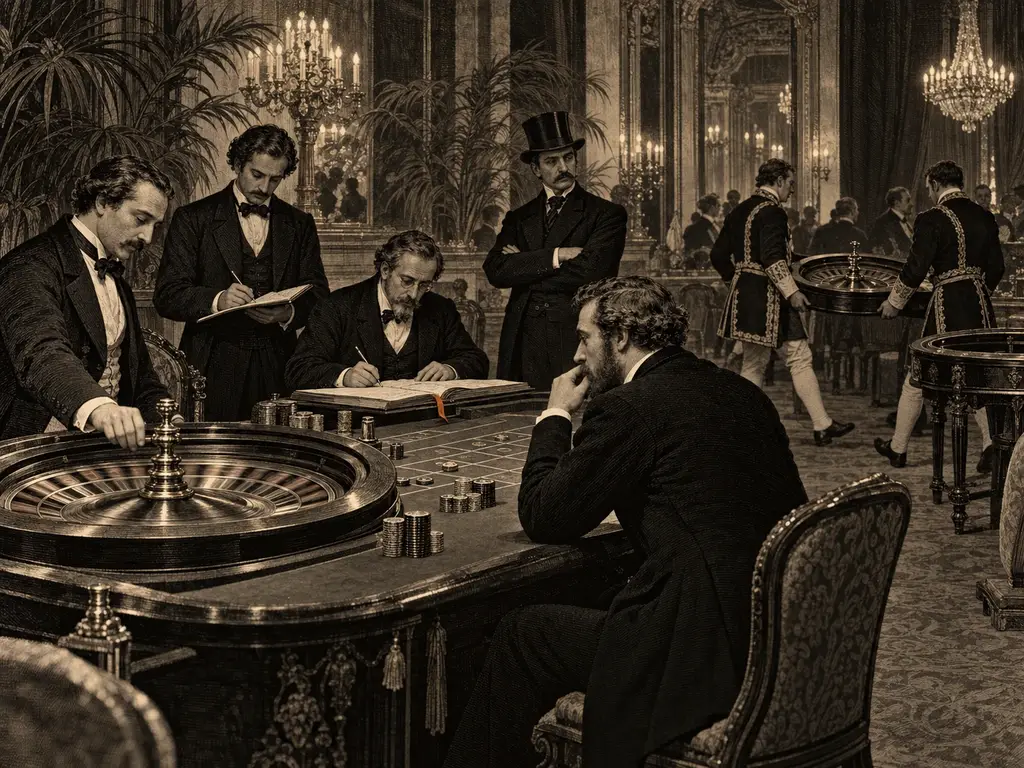
Three approaches have beaten real wheels: exploiting measured bias, timing the ball with a device, and (rarely) exploiting dealer habits. All require a physical wheel, long observation, and are countered or prohibited today.
Bias play
Record thousands of spins from one wheel, find pocketsequipmentPocketOne of the 37 numbered compartments on the rotor. Also: slot, cup.Read full → or sectorswheelSectorA contiguous arc of pockets on the wheel, as distinct from a group on the layout.Read full → that hit more often than 1/37, bet them, win until the casino notices. Joseph Jagger did it at Monte Carlo around 1880, and Richard Jarecki at Sanremo in the 1960s. The García-Pelayo family did it near Madrid in the early 1990s, with about 5,000 recorded spins per wheel and a program of their own. The casino barred them, the government overruled the ban, and in 2004 the Supreme Court agreed that watching a wheel and betting on what it shows breaks no rule of the game. Bias play is now defeated by routine wheel maintenance and by rotating wheel headsequipmentWheel headSynonym for rotor: the spinning part carrying the numbers.Read full → between bowlsequipmentBowlThe fixed outer part of the wheel: the wooden or composite rim that holds the ball track and apron, inside which the rotor spins.Read full →.
Jagger, Monte Carlo. Bias. Wins a fortune; the casino moves its wheels about, then replaces them.
Thorp and Shannon build a wearable computer to time ball and rotor. It works in the lab; wires break on the floor.
The Eudaemons. Hidden digital computers in Nevada, first worn under the arm, then built into shoes. Edge real, hardware unreliable, project ends.
García-Pelayo family. Bias, near Madrid. Win, are barred; the courts overturn the ban in 2004.
Three players at the Ritz, London, win £1.3 million over two nights by betting late on predicted sectors. Press reports of a laser scanner are never substantiated; no charge is brought and they keep the money.
Small and Tse publish the physics: a few percent edge under lab conditions with full view and late bets.
Live studios close bets at the launch. Devices are criminal in most jurisdictions. Wheels are measured on schedule.
Prediction devices
From Thorp and Shannon’s 1961 prototype to the Eudaemons’ hidden computers to phone-camera trackers in the 2000s, the idea is the same: time the ballequipmentBallThe small ball launched along the track against the rotor. Modern balls are ivorine or Teflon, 18–21 mm.Read full → and rotorequipmentRotorThe spinning part of the wheel that carries the pockets.Read full → during the track phase, estimate the drop point, bet a sector. The physics works. Edges from a few percent to a few tens of percent have been reported under good conditions. The practical problems are hardware reliability, the need to bet after the launch, and the law: casinos ban devices, most jurisdictions criminalize them, and live studios close betting before the ball slows.
Dealer signatures
The hypothesis, also called wheel clocking, that a dealer’s launch is consistent enough to predict the drop sector relative to the launch point. Plausible in principle, unproven in public data, and countered by instructing dealers to vary and rotating them every half hour. Covered on its own page. The trick has also run the other way: 19th-century cheating wheels had every other fretequipmentFretThe metal divider between two pockets on the wheel.Read full → slightly raised, so a croupierpeopleCroupierThe dealer at a roulette table.Read full → who saw which color carried less money could favor it by the direction of the spin.
What is left
For a maintained wheel in a licensed casino or studio, nothing that works from the player’s seat. Betting systems never did; the Strategy section shows why. Bias requires a defect the casino has not found first. Timing requires equipment the casino prohibits and a betting windowliveBetting windowThe period in a live round during which bets are accepted, timed by the game server and shown as a countdown.Read full → the studio has closed. The Lab exists to say this with the numbers, not to hint otherwise.
Legal position
Bias play by observation is legal almost everywhere; casinos respond by exclusion, which is their right. Electronic prediction devices are specifically illegal in Nevada, the UK, most of the EU and Australia, with criminal penalties. Dealer-signature play is legal and ineffective. The 2004 Ritz case was the last large public win; the players kept the money, and the Gambling Act 2005 later replaced the old cheating offense with a broader one that has not been tested against prediction by eye.
Why a site about roulette says this
Because the alternative is to let the reader believe that somewhere there is a method, and to keep paying 2.70% while looking for it. The honest version of the Lab is the one that explains the physics well enough that the reader can see where the randomness is manufactured and why it is safe.
Questions
In principle. In practice the data takes longer to collect than the maintenance cycle.
Comic relief
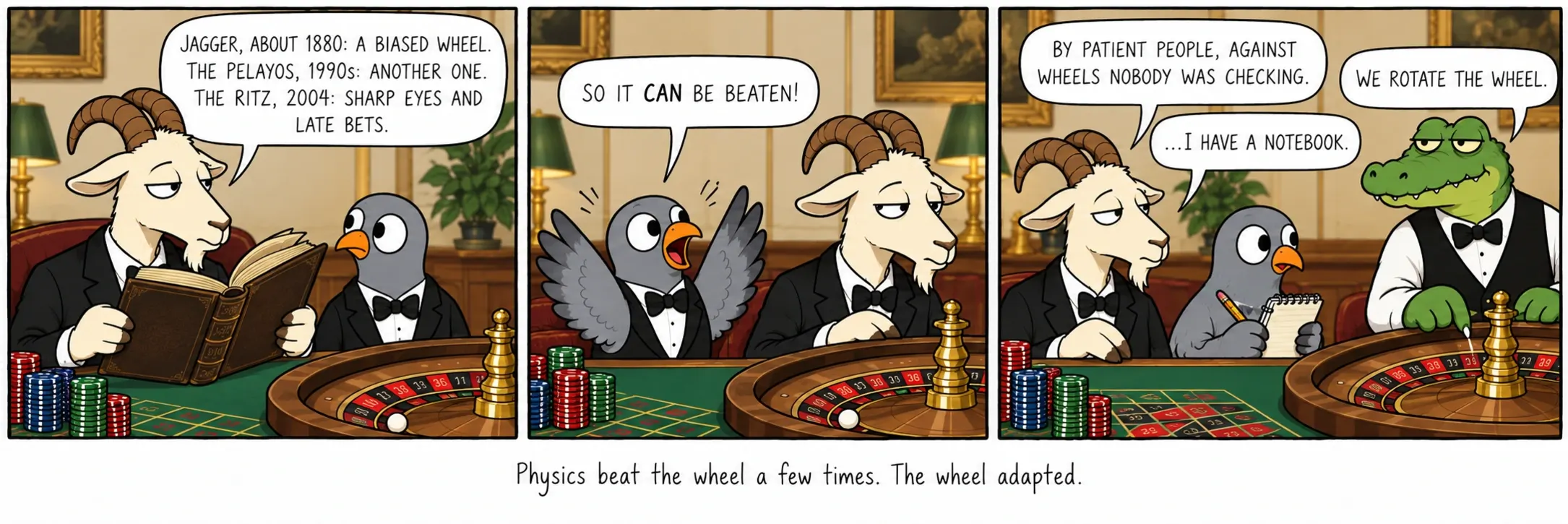
Physics beat the wheel a few times. The wheel adapted.
Sources
- Bass, T. A. The Eudaemonic Pie.
- Thorp, E. O. “Optimal gambling systems for favorable games.”
- Thorp, E. O. The Mathematics of Gambling.
- Thorp, E. O. “The invention of the first wearable computer.”
- Small, M. & Tse, C. K. “Predicting the outcome of roulette.”
- Barnhart, R. T. Beating the Wheel.
- Bollman, M. Mathematics of the Big Four Casino Table Games: Blackjack, Baccarat, Craps, & Roulette.
- Chellel, K. “The Gambler Who Beat Roulette.”
- Goldman, N. Great Gambling Scams.