Can You Beat Roulette?
Not with a betting pattern. Possibly, historically, with a defective wheel or a predictable dealer, and only with enormous effort.
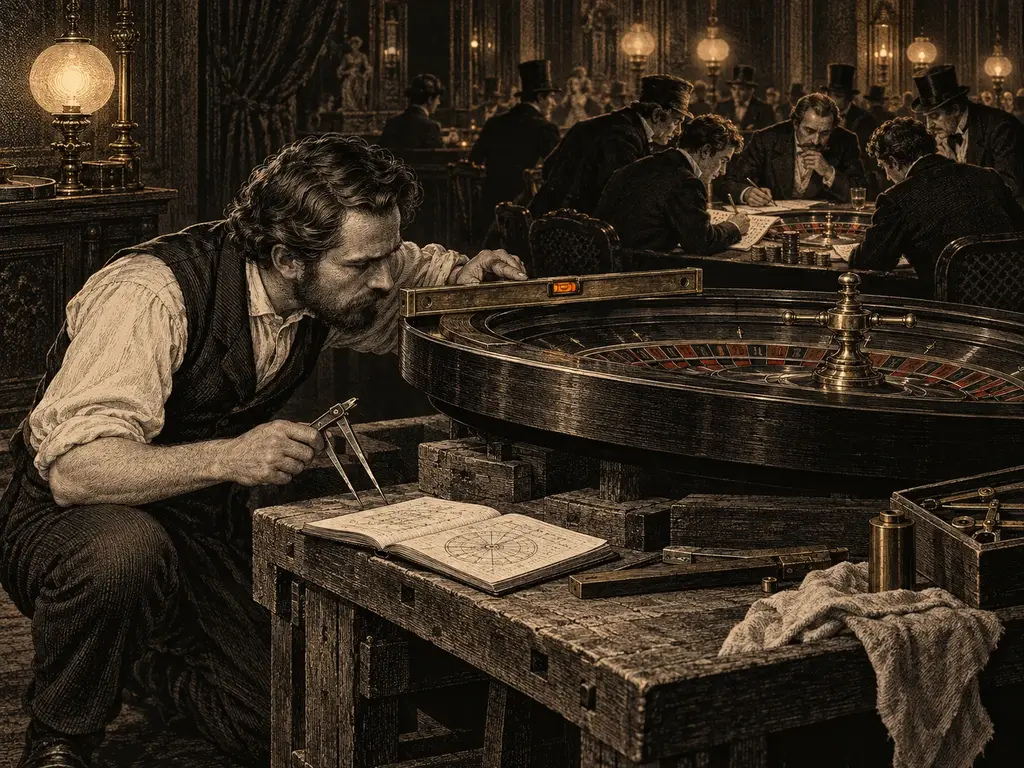
Betting systems cannot beat roulette: expected valuesmathExpected valueThe average result per bet over the long run. −1/37 of the stake for every standard European bet.Read full → add and every bet is negative. The only documented wins came from exploiting physics, not patterns.
Why systems fail
Every bet has EV = −1/37 of its stake. Any sequence of bets, however chosen from past results, has EV = −1/37 of the total staked. This is a theorem about sums of random variables, not an observation that a better system might overturn. Joseph Doob and Paul Halmos proved it in the 1930s, and Edward Thorp, who did beat blackjack by counting cards, set out the conditions it needs: every bet negative, independent spinsmathIndependent spinsEach spin has the same probabilities regardless of history. The basis for every calculation on this site.Read full →, a table maximum and a table minimum. His 1966 textbook gives an elementary proof.
What has worked
Three things, all involving the physical wheel. Bias: a wheel whose pocketsequipmentPocketOne of the 37 numbered compartments on the rotor. Also: slot, cup.Read full → are not equally likely, found by recording thousands of spins. Prediction: timing the ballequipmentBallThe small ball launched along the track against the rotor. Modern balls are ivorine or Teflon, 18–21 mm.Read full → and rotorequipmentRotorThe spinning part of the wheel that carries the pockets.Read full → to estimate the drop sectorwheelSectorA contiguous arc of pockets on the wheel, as distinct from a group on the layout.Read full →, done with hidden computers from the 1970s onward. Dealer signature: the hypothesis that a dealer’s release is consistent enough to predict the drop, never convincingly demonstrated. All three require a physical wheel, long observation and a casino that has not noticed.
Joseph Jagger has the wheels at Monte Carlo recorded, finds numbers that come up too often, and wins heavily until the casino moves its wheels about and then replaces them.
Charles Wells “breaks the bank” with extraordinary luck and a system he never explained. He returns that winter and loses part of it back.
Edward Thorp and Claude Shannon build the first wearable computer to time a roulette ball. The hardware works intermittently; the project is abandoned.
The Eudaemons from Santa Cruz use hidden computers in Nevada casinos. A real edge, unreliable electronics, no fortune.
Gonzalo García-Pelayo and family record about 5,000 spins per wheel near Madrid, find biased wheels, win, are barred, and see the ban overturned in court.
Three players win £1.3 million at the Ritz in London by predicting the ball’s drop. A laser was reported but never shown to exist; they keep the winnings.
Small and Tse publish a physics paper showing a few percent edge is achievable with timing under lab conditions.
Why it no longer works
Casinos rotate wheel headsequipmentWheel headSynonym for rotor: the spinning part carrying the numbers.Read full → between bowlsequipmentBowlThe fixed outer part of the wheel: the wooden or composite rim that holds the ball track and apron, inside which the rotor spins.Read full →, level the bowls, measure pockets and replace fretsequipmentFretThe metal divider between two pockets on the wheel.Read full → on schedule, which defeats bias. Live studios close betting before the ball slows and fix the stream delay, which defeats timing. Most jurisdictions criminalize prediction devices. Dealers are instructed to vary their release. The honest answer for a modern, maintained wheel in a licensed casino or studio is no.
What “beating” would require
Suppose a pocket hits 1 in 33 instead of 1 in 37. A straight upbetStraight upA single number, pays 35:1.Read full → on it has EV = 35/33 − 32/33 = +3/33 ≈ +9%. To know that the pocket is biased rather than lucky you need roughly 10,000 recorded spins from that specific wheel; to exploit it you need the wheel to stay unchanged while you bet it. The Lab pages explain the statistics; the history pages explain what happened to the people who did it.
The honest answer
For the reader with a system: it will not work, and you can verify that with the simulators on this site in an afternoon. For the reader with a notebook and patience: bias exists in principle and is engineered out in practice. For everyone: roulette is a purchase. Pay a price you are happy with, at a pace you choose, on a wheel with one zerowheelZeroThe single green pocket that no even-money, dozen or column bet covers; the source of the house edge. Also: single zero, 0.Read full → and la partageruleLa partageFrench rule: when zero hits, half of an even-money stake is returned. Halves the house edge on those bets to 1.35%.Read full → if you can find it.
Questions
No. Famous system “winners” like Charles Wells won with luck and lost part of it back.
In principle. In a modern casino or studio it would be detected and fixed before you had enough data to exploit it.
Not in most jurisdictions, and not usable against live tables that close betting before the ball slows.
Comic relief
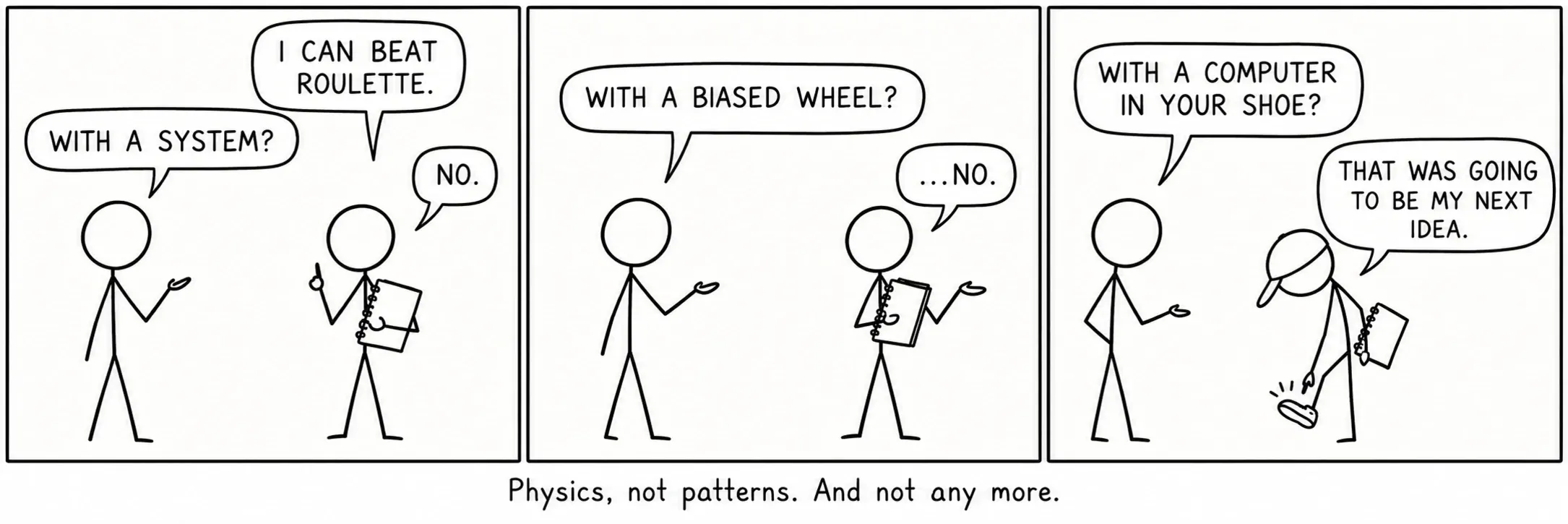
Physics, not patterns. And not any more.
Sources
- Thorp, E. O. “Optimal gambling systems for favorable games.”
- Thorp, E. O. Elementary Probability.
- Doob, J. L. “Note on probability.”
- Halmos, P. R. “Invariants of certain stochastic transformations: the mathematical theory of gambling systems.”
- Bass, T. A. The Eudaemonic Pie.
- Small, M. & Tse, C. K. “Predicting the outcome of roulette.”
- Barnhart, R. T. Beating the Wheel.
- Chellel, K. “The Gambler Who Beat Roulette.”