Walkthrough: Two Dozens
Ten dollars on each of two dozens, 24 numbers covered, for fifty spins. The coverage bet that wins two spins in three and still costs 2.70%.
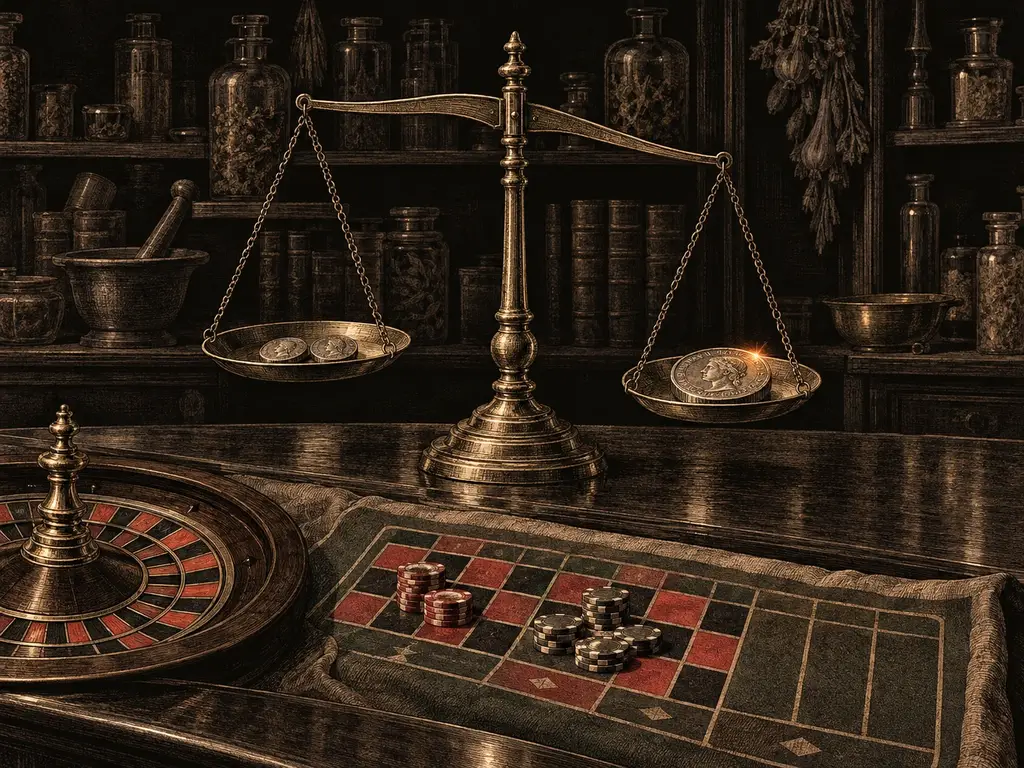
A simulated 50-spin session of $10 on the first and second dozens. Thirty-one wins of $10, nineteen losses of $20 (third dozen or zero). Net −$70, having been up $90. The bet that feels safe because it wins often and is priced exactly like every other.
The plan
$10 on the first dozenbetDozen1–12, 13–24 or 25–36, pays 2:1.Read full → and $10 on the second. A number from 1 to 24 pays one dozen $20 and loses the other $10: +$10. A number from 25 to 36, or zerowheelZeroThe single green pocket that no even-money, dozen or column bet covers; the source of the house edge. Also: single zero, 0.Read full →, loses both: −$20. Expected valuemathExpected valueThe average result per bet over the long run. −1/37 of the stake for every standard European bet.Read full →: (24 × 10 − 13 × 20)/37 = −20/37 = −$0.54 per spin, which is 2.70% of $20. Win rate 64.9%, which is the figure that sells the bet.
Spins 1–25
Eighteen wins, seven losses: +$180 − $140 = +$40. The seven losses included zero once and a run of three third-dozen numbers at spins 11–13 that cost $60 in a row and felt like the exception. It was the 35.1% arriving in a clump, which clumps do.
Spins 26–50
Thirteen wins, twelve losses: +$130 − $240 = −$110. Twelve losses in 25 spins is a 20% event, not rare. Final −$70; peak +$90 at spin 31. The bet never produced a large swing in either direction, because the win is $10 and the loss $20; it simply ground.
- p10 −$500
- p25 −$500
- median −$280
- p75 −$40
- p90 +$170
The accounts
Total wagered $1,000 over 50 spins. Expected lossmathExpected lossExpected value times total amount wagered; the average amount lost over a session or a period.Read full → $27; actual −$70, about one standard deviationmathStandard deviationSquare root of variance; the typical distance of a result from the expected value.Read full → below (σ per spin is about $14, so about $100 over 50 spins). The same $20 on redbetRedEven-money bet on the 18 red numbers. French: rouge.Read full → would have had the same expectation and a larger σ, about $140 over the session: two dozens is a lower-variancemathVarianceA measure of how widely results spread around the expected value. High for straight up, low for even-money bets.Read full → way to lose the same amount.
What the session shows
Covering 24 numbers makes roulette feel like a game you usually win, and you do: 64.9% of spins. The payoutmoneyPayoutWhat a winning bet returns, quoted as “X to 1” on top of the returned stake.Read full → is set so that the 35.1% you lose costs twice what the wins pay, and the ratio is tuned by the layoutequipmentLayoutThe printed betting grid on the table. Also: table, felt, cloth.Read full → to −1/37 of the total stake. Add a chipmoneyChipA token representing a fixed amount, placed on the layout to make a bet. Also: check.Read full → on zero for “insurance” and the blended edge is still 2.70%, because the insurance is priced at 2.70% too. The math problem on that page works it through.
Questions
Same arithmetic: 24 numbers, +1 unitmoneyUnitThe base stake a system or a player works in. Progressions are described in units so they apply at any table.Read full → on a hit, −2 on a miss. ColumnsbetColumnTwelve numbers in one vertical column of the layout, pays 2:1.Read full → spread the covered numbers across the wheel; dozens cluster them on the layout. Neither matters.
Covers 25 numbers; zero now nets +$16 instead of −$20 at a cost of $1 per spin. The expected value is −$0.57 on $21, still 2.70%.
It is, and the pay-off is sized to it. Most of the time you win $10. Some of the time you lose $20. The average is the house edgemathHouse edgeThe share of each stake the casino keeps on average: 2.70% in European roulette.Read full →.
Comic relief
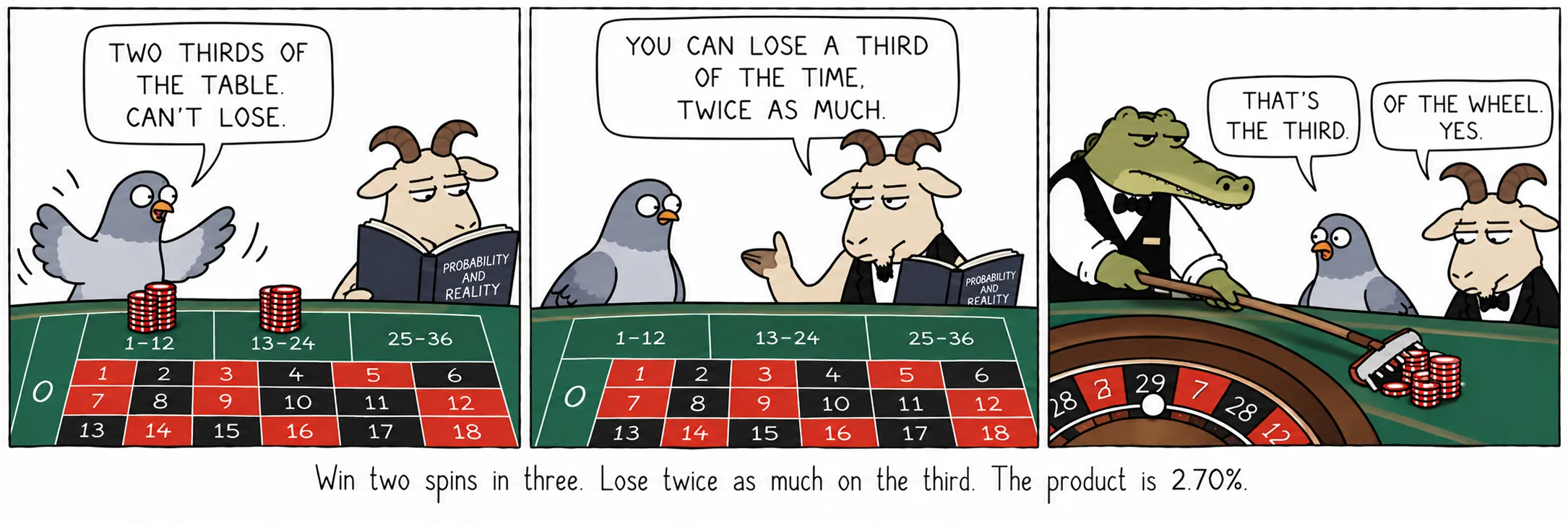
Win two spins in three. Lose twice as much on the third. The product is 2.70%.
Sources
- Ethier, S. N. The Doctrine of Chances: Probabilistic Aspects of Gambling.