Rotor Speed
How fast the numbers go past, and why that matters more than the ball.
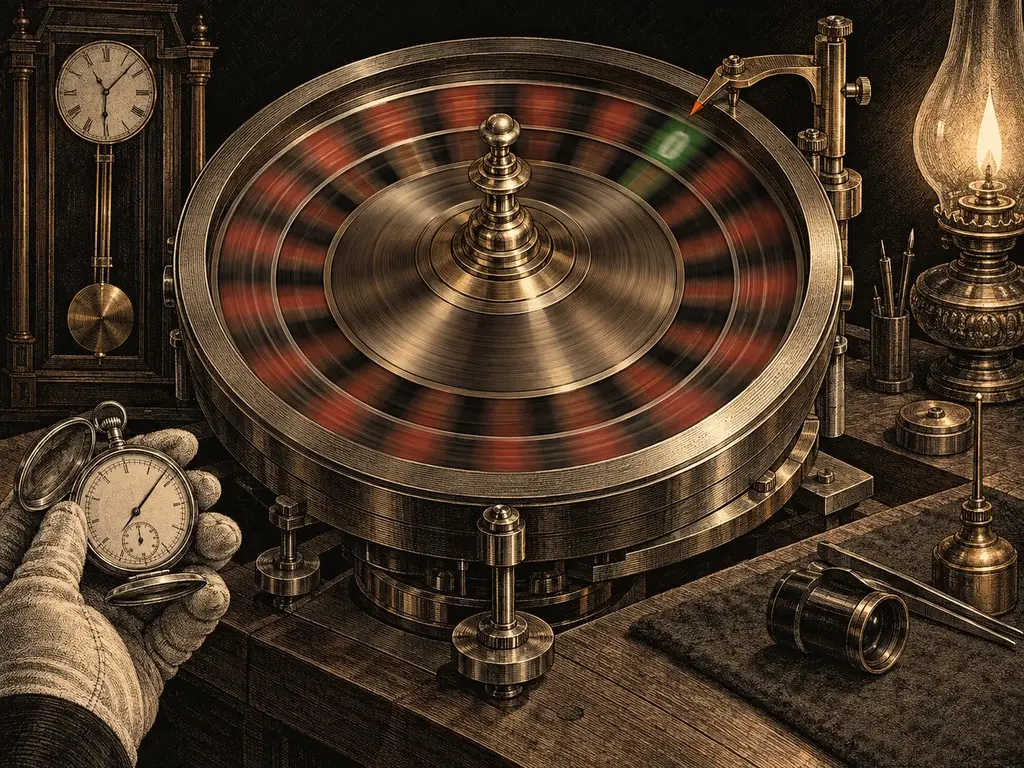
Typical rotors turn at 0.3–0.5 rev/s and lose speed slowly. Over a 15-second ball flight the rotor turns 5–7 times, so a small timing error becomes a large pocket error.
Measuring it
Time one full revolution of the zerowheelZeroThe single green pocket that no even-money, dozen or column bet covers; the source of the house edge. Also: single zero, 0.Read full → pocketequipmentPocketOne of the 37 numbered compartments on the rotor. Also: slot, cup.Read full → past a fixed reference such as a deflectorequipmentDeflectorOne of the metal obstacles on the apron that scatter the falling ball. Also: canoe, diamond, pin.Read full →; repeat three times and average. On a live stream you can do this from the video, allowing for the fact that the stream is a replay. RotorequipmentRotorThe spinning part of the wheel that carries the pockets.Read full → speeds vary by dealer: some give a harder push. Houses specify a minimum (so the wheel is never nearly stopped) and dealers top it up between rounds.
Why predictors care
Any estimate of where the ballequipmentBallThe small ball launched along the track against the rotor. Modern balls are ivorine or Teflon, 18–21 mm.Read full → will drop must be matched to where the rotor will be at that instant. At 15 pockets per second, a 0.1-second error in the drop time is 1.5 pockets; a 0.5-second error is almost a quarter of the wheel. Rotor phase is the easy half of the problem, because the rotor is heavy and decays slowly; ball drop time is the hard half.
Decay
A good rotor bearing loses only a few percent of its speed over a one-minute round, so for the duration of a ball flight the rotor can be treated as constant. Over a shift it would stop without the dealer’s push. Predictors measure the rotor once per round; the ball several times per round.
Direction
Dealers alternate rotor direction between rounds in many houses. The ball is always launched against the rotor. Changing direction changes the scatter pattern, because the ball strikes the deflectors from the other side, so a predictor needs two scatter distributions per wheel.
What a player can take from this
Nothing about the odds. The rotor is a clock, and knowing its speed tells you how fast the pockets pass, which is only interesting if you also know when the ball will drop. For the Lab’s bias analysis the rotor speed is irrelevant: bias is about which pockets are favored over thousands of spins, not about where the rotor is at any one moment.
Questions
It makes timing harder and scatter wider. The odds are 1/37 per pocket regardless.
To keep it above the house minimum speed. A slow rotor is easier to time.
Comic relief
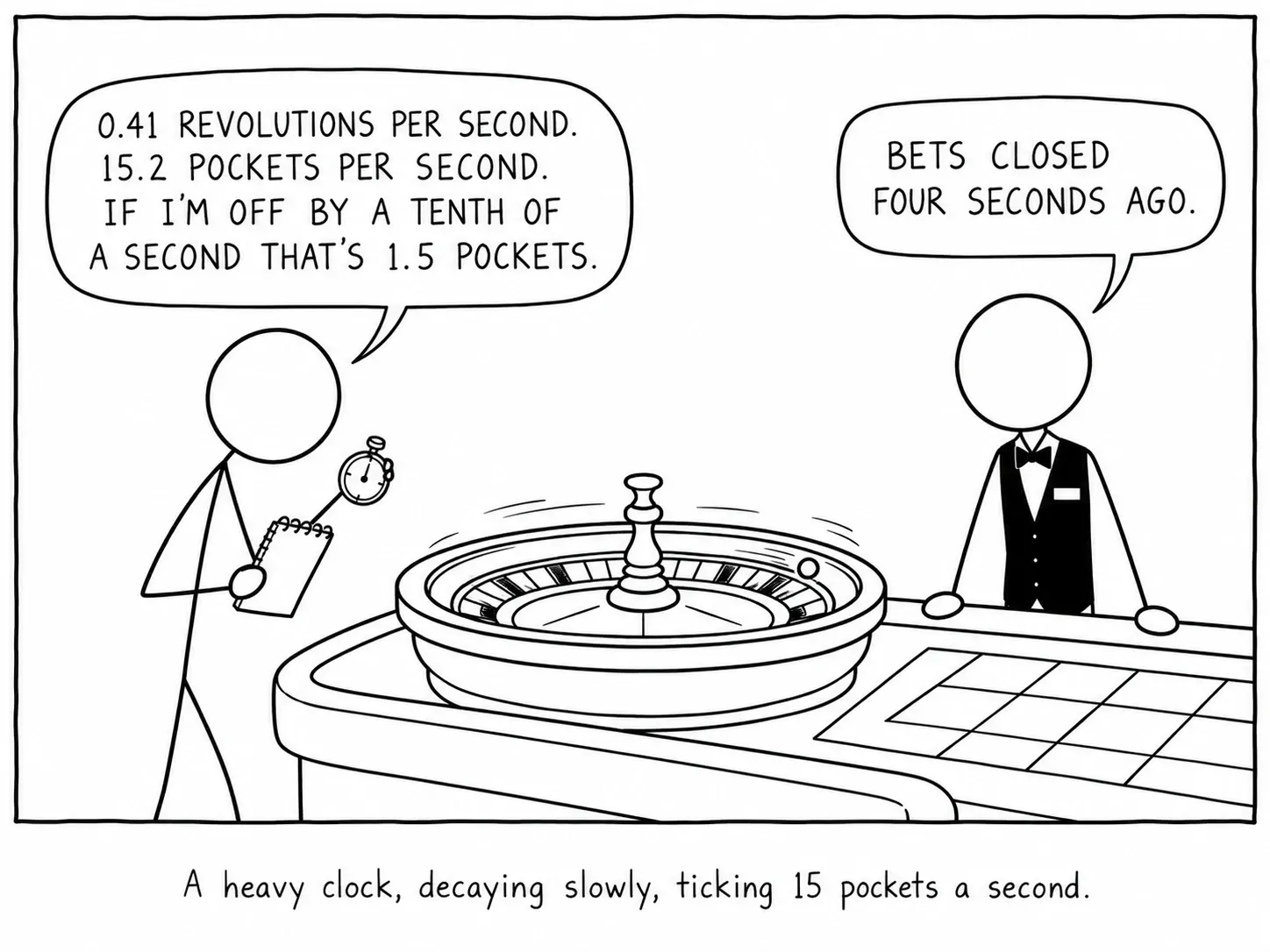
A heavy clock, decaying slowly, ticking 15 pockets a second.
Sources
- Small, M. & Tse, C. K. “Predicting the outcome of roulette.”
- Barnhart, R. T. Beating the Wheel.