Roulette in the United Kingdom
Single-zero casinos since 1968, and for twenty years the fastest, most expensive roulette in the country sat in betting shops.

British casinos have run single-zero roulette since the Gaming Act 1968, long with half the stake back on zero for even-money bets. From 1999 betting shops added roulette machines that took £100 a spin every 20 seconds, about £486 an hour in expected losses at the top stake. In April 2019 the top stake fell to £2.
Casinos
The Gaming Act 1968 let commercial casinos open in Great Britain as members’ clubs, licensed under the eye of a new Gaming Board. Only members and their guests could play, and a new member had to wait 48 hours after applying before the first bet, a rule cut to 24 hours in 1999 and dropped in October 2005, when the Gambling Commission replaced the Gaming Board. Regulations of 1994 fixed the game itself: a wheel of 37 compartments numbered 0 to 36, and on an even-money betbetEven-money betRed/black, odd/even, high/low. 18 numbers, pays 1:1.Read full → a zerowheelZeroThe single green pocket that no even-money, dozen or column bet covers; the source of the house edge. Also: single zero, 0.Read full → returned half the stake, which costs the player the same 1.35% as la partageruleLa partageFrench rule: when zero hits, half of an even-money stake is returned. Halves the house edge on those bets to 1.35%.Read full →. Those rules lapsed in 2007 under the Gambling Act 2005, and casinos now set their own; single zero is still the norm and half back on zero is common. Check the table’s rules.
Roulette in the betting shop
Fixed-odds betting terminals, gaming machines in betting shops, arrived in 1999 and spread fast after a tax change in 2001. Under an industry code from 2003 the only casino game they offered was roulette, and the law later placed them in category B2, at most four to a shop. A player could stake up to £100 a spin, every 20 seconds, for a top prize of £500. The game was single-zero roulette, returning 97.3%. At their peak, in 2014–15, there were about 35,000 of them.
What a spin every 20 seconds costs
Speed matters as much as the stake. At three spins a minute a player makes 180 bets an hour, and the 2.70% edge applies to every one of them. At £100 a spin that is £18,000 staked and about £486 lost an hour on average, the figure the government used when it cut the stake. At £2 it is £9.73.
Who played them
The British Gambling Prevalence Survey of 2007 found that 11.2% of people who played these machines met its test for problem gambling, against 0.6% of adults overall; the sample of machine players was small, about 200. Later surveys quoted by the government gave 11.5% in 2015 and 13.6% in 2016 for players of all machines in betting shops. A survey cannot say whether the machines caused the problems or drew people who already had them, but concern about high stakes, fast play and harm led the government to announce the cut in May 2018; it took effect on 1 April 2019.
Online, and advice
Online roulette in Britain is licensed by the Gambling Commission under the Gambling Act 2005; the Europe page covers that market and GAMSTOP, the national self-exclusion register. For a player the lesson of the machines is the arithmetic of speed: the price of roulette is 2.70% of everything staked, and a game that takes three bets a minute takes that price three times a minute. Choose a slow table, a small stake and a half-back-on-zero rule for even-money bets.
Questions
On some machines, at up to £2 a spin since April 2019; most of the old high-stake machines were moved to a lower category.
Yes, as a rule, and even-money bets often return half the stake on zero. Check the table’s rules.
The legal category, under the Gambling Act 2005, of the gaming machines in betting shops that took up to £100 a spin; since April 2019 their limit is £2.
Comic relief
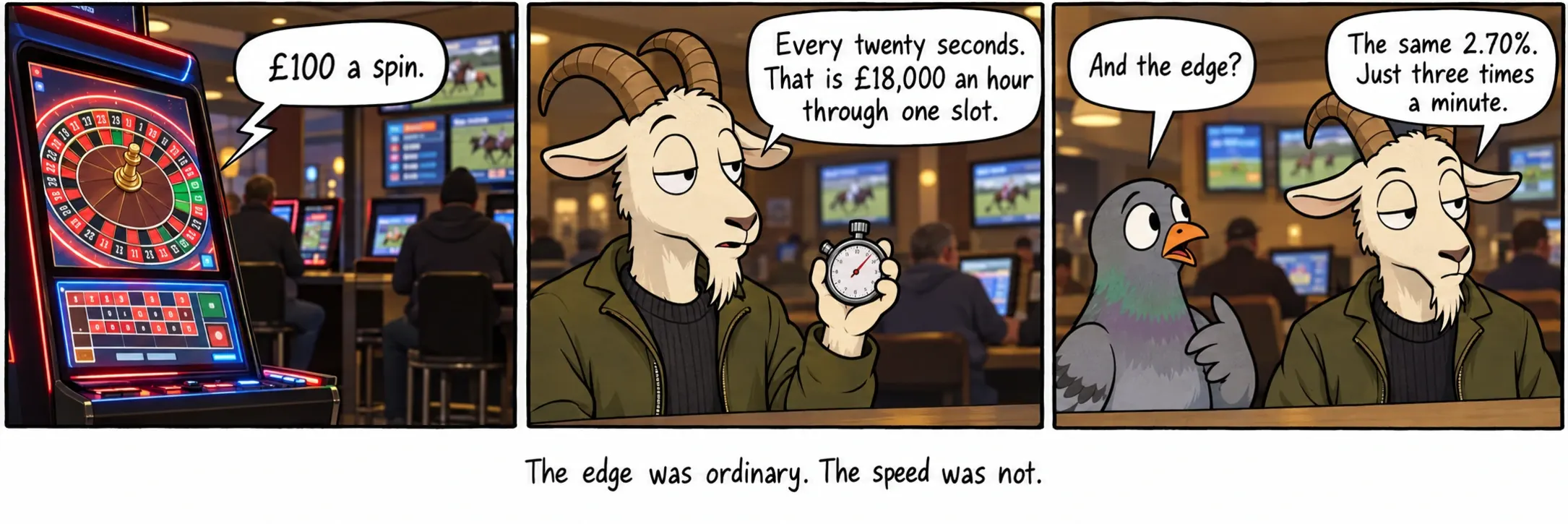
The edge was ordinary. The speed was not.
Sources
- Department for Digital, Culture, Media and Sport. Government response to the consultation on proposals for changes to gaming machines and social responsibility measures.
- Woodhouse, J. Fixed odds betting terminals.
- Gambling Commission. Industry statistics, November 2020.
- Wardle, H. et al. British Gambling Prevalence Survey 2007.
- Gaming Act 1968 (c. 65).
- Gaming Clubs (Bankers’ Games) Regulations 1994 (SI 1994/2899).
- Statutory Instrument 2018/1402.
- UK Gambling Commission. Remote gambling and software technical standards.