Bankroll Management
Decide the budget, the stake and the stop rule before the first spin.

Bankroll management does not change the odds. It controls how long you play, how much you can lose, and whether you stop while a decision is still yours.
Three numbers before you sit down
The budget: an amount whose loss changes nothing about tomorrow. The stake: a fraction of the budget that gives the session the length you want. The stop: a loss at which you leave and, optionally, a win at which you leave. Written down, these three numbers are the entire content of bankrollmoneyBankrollThe total amount set aside for play. Bankroll management is deciding how much of it to risk per bet and per session.Read full → management. Everything else on the subject is commentary.
Sizing the stake
Budget divided by stake is the number of losing bets you can absorb. With even-money betsbetEven-money betRed/black, odd/even, high/low. 18 numbers, pays 1:1.Read full → a $500 budget at $5 lasts about 100 spins at the median and almost never busts in 100; at $25 straight-up bets a bust inside 20 spins is common. Decide the pace you want and size the stake from it. A common rule is 1–2% of the budget per even-money bet, which gives sessions of several hundred spins.
Expected cost
Expected lossmathExpected lossExpected value times total amount wagered; the average amount lost over a session or a period.Read full → per hour ≈ stake × spins per hour / 37. At $10 and 50 spins an hour that is $13.50 an hour on a European wheel, $6.75 on a French one, $27 on a speed table. Treat it as the price of the entertainment and compare it with what else that money buys. The number is honest in a way that a session’s result never is: a winning night does not mean the price was lower.
Drawdown
Even at a sensible stake, a session will spend most of its time below the starting balance. The expected path drifts down at 2.70% of turnovermoneyTurnoverThe total amount wagered over a session or period, counting re-bet winnings. Also: handle, action.Read full →; the actual path wanders around it with a spread that grows like the square root of the spins. A $10 flat bettor on redbetRedEven-money bet on the 18 red numbers. French: rouge.Read full → will, in a typical 100-spin session, see the bankroll dip by $80 to $120 at some point. Knowing that in advance is the difference between a plan and a panic.
- p10 −$440
- p25 −$280
- median −$140
- p75 +$20
- p90 +$160
Responsible play
Set a deposit or session limit where the operator offers one; most licensed sites do. Never increase the budget during a session: the money you “need to win back” is already gone and the next spin does not know about it. If stopping feels difficult, that is the signal to stop. Help lines are listed on the responsible gambling page and in the footer of every page on this site.
- Decide the budget before you log in or sit down.
- Do not play with money needed for anything else, and never with borrowed money.
- Take breaks. Pace is the biggest lever on expected loss per hour.
- A losing session is the expected outcome, not a sign to continue.
Questions
No. It controls cost and duration. The odds are the wheel’s.
Budget ÷ 100 for even-money bets gives a session that almost never busts in 100 spins. Budget ÷ 300 for straight upsbetStraight upA single number, pays 35:1.Read full →.
Any rule for changing the stake is a progressionstrategyProgressionAny rule that changes the stake based on previous results. Negative progressions raise it after losses, positive after wins.Read full →, and progressions do not change the expected loss. Bet what the plan says.
Comic relief
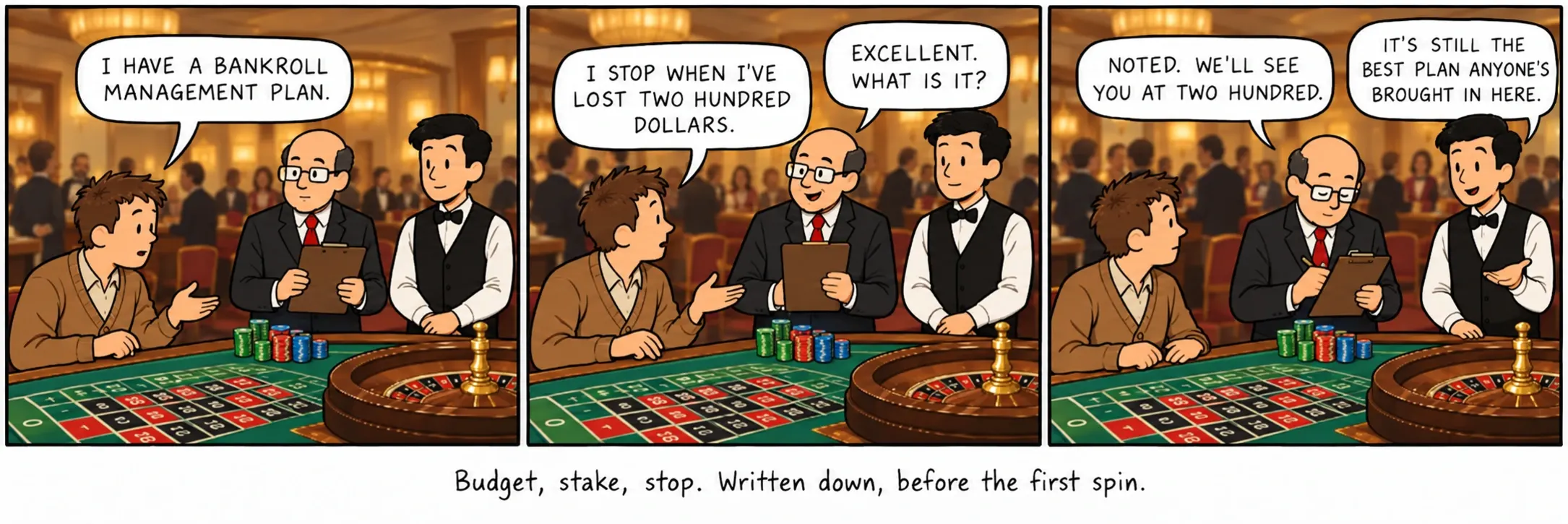
Budget, stake, stop. Written down, before the first spin.
Sources
- Ethier, S. N. The Doctrine of Chances: Probabilistic Aspects of Gambling.
- Feller, W. An Introduction to Probability Theory and Its Applications, Vol. 1.