D'Alembert
Add one unit after a loss, remove one after a win.

It does not beat the wheel. It is the flattest common progressionstrategyProgressionAny rule that changes the stake based on previous results. Negative progressions raise it after losses, positive after wins.Read full →: stakes drift up slowly, drawdowns are moderate, and the edge is untouched.
Walk the system
A loss moves one step up. A win moves one step back.
Stakes and results are in units of the base bet.
How does the D’Alembert system work?
Bet one unitmoneyUnitThe base stake a system or a player works in. Progressions are described in units so they apply at any table.Read full →. Lose, and the next bet is one unit bigger. Win, and it is one unit smaller, never below one. That is all. Picture a seesaw: every loss tips the stake up a notch and every win tips it back. The belief underneath is that wins and losses will balance, so the stake will come home to the base. The appeal is that every pair of one win and one loss at adjacent stakes nets +1 unit: lose 3, win 4, net +1.
What does a session look like?
Gentle, with a stake that creeps upward. Since losses outnumber wins 19 to 18 on even money, the stake drifts upward over a long session. Because the stake is highest when you have been losing, and lower when winning, the average stake during losing stretches exceeds the average during winning ones. Sessions are smoother than MartingalestrategyMartingaleProgression that doubles the bet after each loss. See the Strategy section for what it does and does not do.Read full →, with moderate drawdownsmoneyDrawdownThe fall from a bankroll peak to a later low within a session. Maximum drawdown is the largest such fall.Read full → and no cliff, and lose a little more than flat bettingstrategyFlat bettingWagering the same amount every spin. The baseline every progression is compared against.Read full → on average because the average stake is higher.
- p10 −$500
- p25 −$500
- median −$500
- p75 −$500
- p90 −$500
Does the D’Alembert system work?
No. A balanced session wins, and sessions do not stay balanced. After w wins and l losses at adjacent stakes the net result is w − l units plus a correction for where in the ladder you were. If w = l the result is exactly +w units, which looks like a guaranteed profit. The catch is that w = l is not the expected case: over 37 spins you expect 18 wins and 19 losses. One extra loss at a stake that has climbed to, say, 8 units costs more than eight of the +1 pairs produced. The expectation works out to −1/37 of total turnovermoneyTurnoverThe total amount wagered over a session or period, counting re-bet winnings. Also: handle, action.Read full →, as it must.
Why do short sessions usually win?
The balanced case is part of one rule that covers every session. Call D the number of losses minus the number of wins. A session of N spins that starts at one unit ends at (N − D²)/2 − D units, as long as no bet of one unit wins (after such a win the stake has nowhere lower to go). With D = 0 that is +N/2, the +w of the section above. Each extra loss counts squared: after 100 spins a D of 4 still leaves +38 units, a D of 8 leaves +10, and a D of 10 leaves −10. Chance alone spreads D by about √N, ten after 100 spins, and in a game with no zerowheelZeroThe single green pocket that no even-money, dozen or column bet covers; the source of the house edge. Also: single zero, 0.Read full → the gains of the many balanced sessions and the losses of the few lopsided ones cancel exactly. The zero adds one extra loss every 37 spins on average, and because D is squared its cost grows faster than the session. Most sessions of up to 100 spins end ahead; the average never does, and past a few hundred spins most sessions lose too.
What if you turn it around?
Contra-D’Alembert, also called the reverse D’Alembert, adds a unit after a win and takes one off after a loss. It mirrors the original exactly. As long as no bet of one unit loses, a session of N spins ends at (D² − N)/2 + D units, where D is now the wins minus the losses. A balanced session loses half a unit a spin, and only a run of wins well ahead of the losses turns a profit. So most sessions lose a little and a few win a lot, the opposite of the original’s shape, and the average is the same 2.70% of the money staked.
Who was d’Alembert?
Jean le Rond d’Alembert, mathematician and co-editor of the Encyclopédie, argued in a 1754 article that after a run of heads, tails became more likely. He was wrong, and the fallacy that bears his name is a form of the gambler’s fallacy. The betting system was named after him later, by gamblers who shared the belief. He did not design it and would probably not have endorsed it.
Are there other versions?
Contra-D’Alembert, above, behaves like a gentle ParolistrategyParoliPositive progression: double after a win, reset after a loss or after three wins in a row. Also: reverse Martingale.Read full →. Some players add two units after a loss and subtract one after a win, which steepens the ladder toward Martingale territory. All versions share the same expected lossmathExpected lossExpected value times total amount wagered; the average amount lost over a session or a period.Read full → per unit wagered.
Simulator · D'Alembert
2,000 sessions of even-money bets from a $1,000 bankroll.
Base bet $10 · table limit $500 · 100 spins per session
How often a losing streak comes
An even-money bet on a single-zero wheel loses 19 spins in 37. Each row is the chance that a given run of spins all lose, and what a D’Alembert player, who adds one base bet after every loss, has lost by then.
| losses in a row | chance | about 1 in | lost so far | next bet |
|---|---|---|---|---|
| 1 | 51.4% | 2 | $1 | $2 |
| 2 | 26.4% | 4 | $3 | $3 |
| 3 | 13.5% | 7 | $6 | $4 |
| 4 | 7.0% | 14 | $10 | $5 |
| 5 | 3.6% | 28 | $15 | $6 |
| 6 | 1.8% | 55 | $21 | $7 |
| 7 | 0.94% | 106 | $28 | $8 |
| 8 | 0.48% | 207 | $36 | $9 |
| 9 | 0.25% | 403 | $45 | $10 |
| 10 | 0.13% | 784 | $55 | $11 |
| 11 | 0.065% | 1527 | $66 | $12 |
| 12 | 0.034% | 2974 | $78 | $13 |
| 13 | 0.017% | 5792 | $91 | $14 |
| 14 | 0.0089% | 11279 | $105 | $15 |
| 15 | 0.0046% | 21965 | $120 | $16 |
The chance is 19/37 multiplied by itself once per loss, counted from one given spin. A long session has many spins where such a run can start, so over an evening it is far more likely than one row suggests.
Questions
It has no cliff, which makes it the gentlest negative progression. It is not cheaper than flat betting; it is slightly dearer.
Only the table limittableTable limitMinimum and maximum bet allowed. The maximum is what stops doubling progressions.Read full → or your bankrollmoneyBankrollThe total amount set aside for play. Bankroll management is deciding how much of it to risk per bet and per session.Read full →. Over a long losing session it climbs steadily.
Fun with Math
Try these yourself first. Each solution is folded; open it when you are ready.
You play the D’Alembert on redbetRedEven-money bet on the 18 red numbers. French: rouge.Read full → for 50 spins, starting at one unitmoneyUnitThe base stake a system or a player works in. Progressions are described in units so they apply at any table.Read full →, and never win a bet of one unit (after such a win the stake would have nowhere lower to go). You finish with 27 losses and 23 wins. How many units are you up or down? And with 29 losses and 21 wins?
Show the solution
Answer +13 units with 27 losses, −15 units with 29. Two spins out of fifty going the other way cost 28 units.
Call D the losses minus the wins. The result is (N − D²)/2 − D for N spins. With 27 losses and 23 wins, D = 4: (50 − 16)/2 − 4 = 17 − 4 = +13. With 29 and 21, D = 8: (50 − 64)/2 − 8 = −7 − 8 = −15.
Why the rule holds: the stake is always one unit plus the losses so far minus the wins so far. Each loss that a later win cancels makes a pair, lose s and then win s + 1, which nets +1 unit, as the table above shows. Out of N spins, (N − D)/2 such pairs form, worth +(N − D)/2. The D losses left over were placed at stakes 1, 2 … D on the way up and never cancelled; they cost 1 + 2 + … + D = D(D + 1)/2. Together: (N − D)/2 − D(D + 1)/2 = (N − D²)/2 − D.
The square is the whole story. A balanced session pays half a unit a spin, and every step away from balance costs more than the one before.
You play the reverse D’Alembert on red for 100 spins, starting at one unit, and no bet of one unit ever loses. You finish with 52 wins and 48 losses. Where do you stand? And with 60 wins and 40 losses?
Show the solution
Answer −38 units with 52 wins, +170 with 60. A small lead in wins still loses; only a large one pays.
Call D the wins minus the losses. The result is (D² − N)/2 + D for N spins.
52 wins and 48 losses: D = 4, so (16 − 100)/2 + 4 = −42 + 4 = −38.
60 wins and 40 losses: D = 20, so (400 − 100)/2 + 20 = 150 + 20 = +170.
Why: each win that a later loss cancels makes a pair, win at s and then lose at s + 1, which nets −1. The D wins left over were placed at stakes 1, 2 … D on the way up and are never cancelled; they bring in D(D + 1)/2. Out of N spins, (N − D)/2 pairs form, so the total is D(D + 1)/2 − (N − D)/2 = (D² − N)/2 + D.
It is the original D’Alembert’s rule with the signs turned round: there, balance wins half a unit a spin and imbalance is punished; here, balance costs half a unit a spin and imbalance is rewarded.
Comic relief
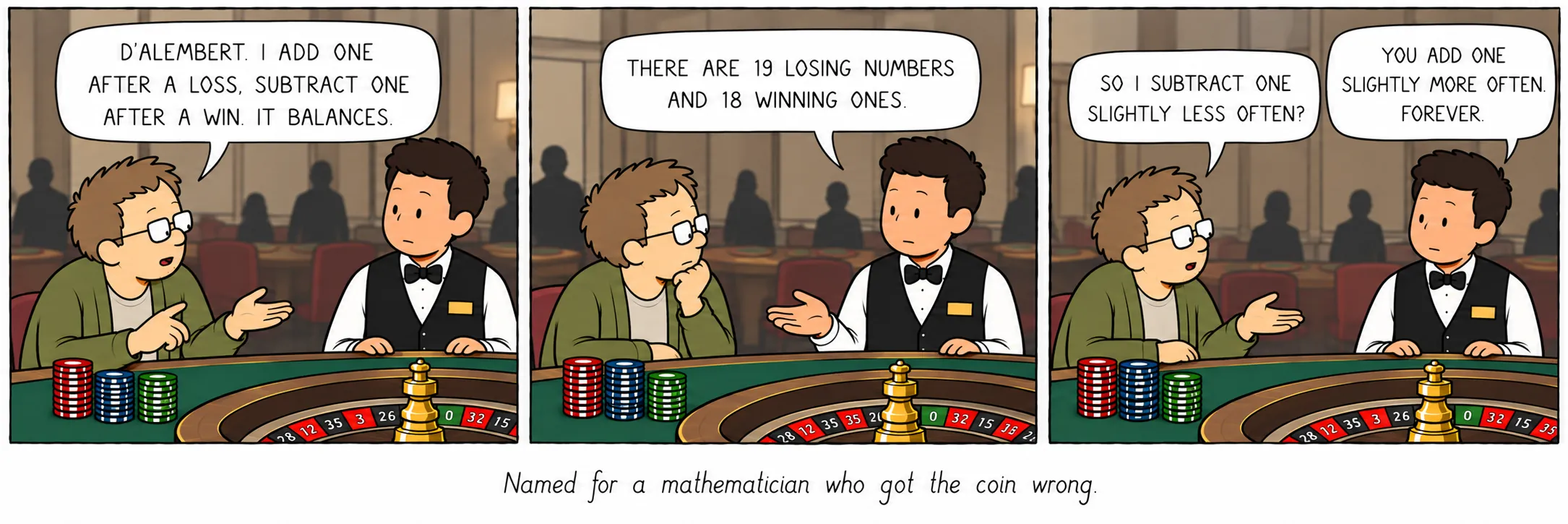
Named for a mathematician who got the coin wrong.
Sources
- d’Alembert, J. “Croix ou pile.”
- Ethier, S. N. The Doctrine of Chances: Probabilistic Aspects of Gambling.
- Epstein, R. A. The Theory of Gambling and Statistical Logic, 2nd ed.