Ball Physics
A small ball on a conical track, held up by speed alone.
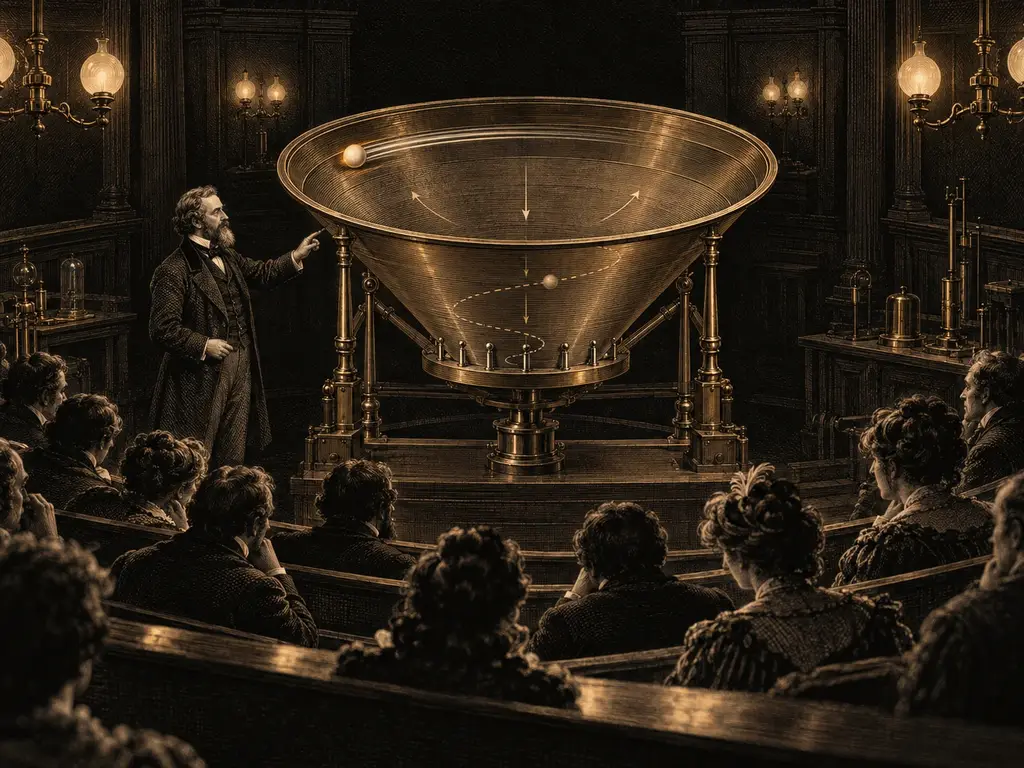
The ball stays on the track while centripetal demand is met by the track’s tilt. As it slows below a threshold speed it rolls down the apron, hits a deflector, and scatters.
The ball
Historically ivory, then ivorine (a celluloid), now usually Teflon or a similar polymer, 18 to 21 mm across, a few grams. Casinos keep several sizes and change them, because a smaller, lighter ballequipmentBallThe small ball launched along the track against the rotor. Modern balls are ivorine or Teflon, 18–21 mm.Read full → bounces more on the fretsequipmentFretThe metal divider between two pockets on the wheel.Read full → and scatters more widely, which is good for the house. The ball must be non-magnetic and is inspected for roundness; an out-of-round ball drops early and erratically.
On the track
On a tilted circular track the ball needs a centripetal force mv²/r to keep turning. The track wall supplies it while the ball is fast. As the ball slows, the required force falls until the inward component of gravity along the tilt exceeds what the geometry can hold, and the ball rolls off. The critical speed depends only on the track’s radius and angle, so on a given wheel the drop speed is nearly constant from spin to spin, typically 1 to 1.3 m/s.
Deceleration pattern
Rolling friction removes energy at a roughly constant rate; air drag removes more when the ball is faster. Together they make each lap a little longer than the last by a predictable increment. Measuring two or three consecutive lap times lets you fit the friction and drag constants and project the lap on which the ball will drop. On a clean wheel the projection is good to a few tenths of a second; this is what timing-based predictors measure, and the deceleration page shows the arithmetic.
Scatter
After leaving the track the ball crosses the apronequipmentApronThe sloped area between the ball track and the pockets, where the deflectors sit.Read full → and usually hits one of eight deflectorsequipmentDeflectorOne of the metal obstacles on the apron that scatter the falling ball. Also: canoe, diamond, pin.Read full →. Which one, and at what angle, decides whether it lands near the “drop pocketequipmentPocketOne of the 37 numbered compartments on the rotor. Also: slot, cup.Read full →” or a quarter-wheel away. It then bounces across the frets, sometimes jumping back out of a pocket it has already entered. Scatter is measured per wheel as a distribution of final pocket relative to the pocket beneath the drop point; on modern wheels it typically spans 10 to 15 pockets either side, and some wheels show two or three modes because particular deflectors are struck more often.
What this means for the player
Everything up to the drop is knowable in principle and useless in practice without equipment and late bets. Everything after the drop is designed to be unknowable. The result is a game whose outcomes are random not because the physics is random but because the information needed to predict them is destroyed between the track and the pocket.
Questions
Not the odds. It changes the scatter: heavier balls bounce less and settle sooner.
To defeat anyone who has calibrated a predictor to one ball, and because balls wear.
Rarely, on a hard launch or a worn track. The spin is void.
Comic relief
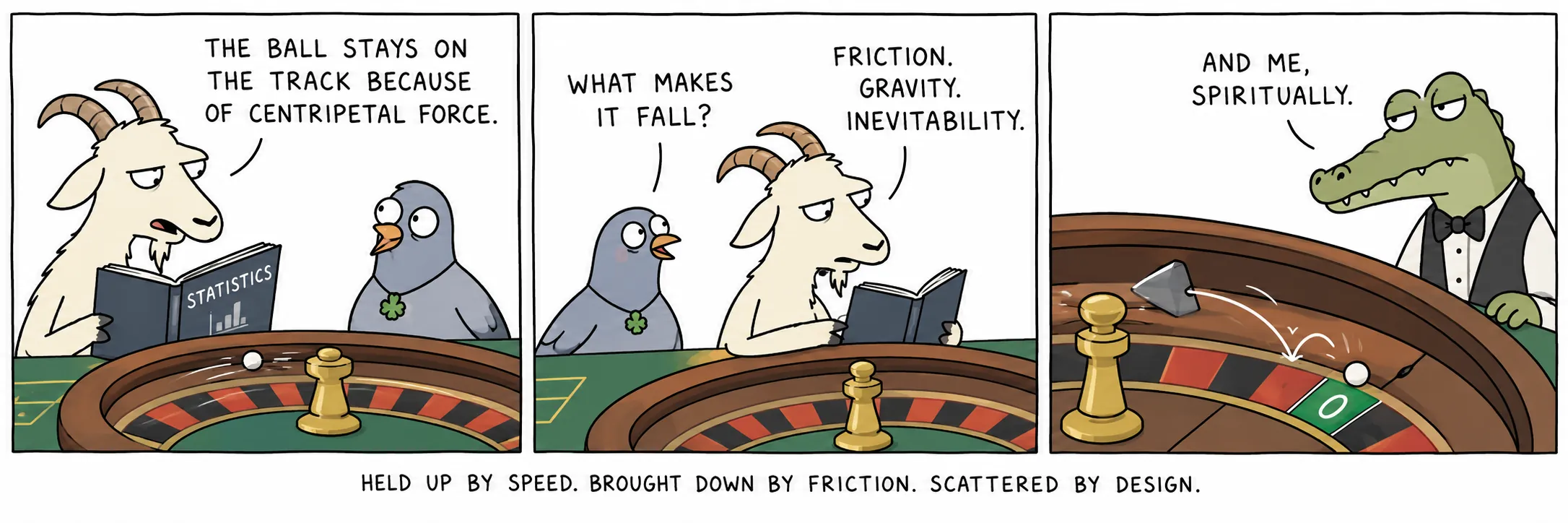
Held up by speed. Brought down by friction. Scattered by design.
Sources
- Small, M. & Tse, C. K. “Predicting the outcome of roulette.”
- Bass, T. A. The Eudaemonic Pie.