Andrucci System
Watch the wheel for a while, find the number that came up most, then bet on it. It sounds like hunting for a biased wheel; the numbers say it is not.
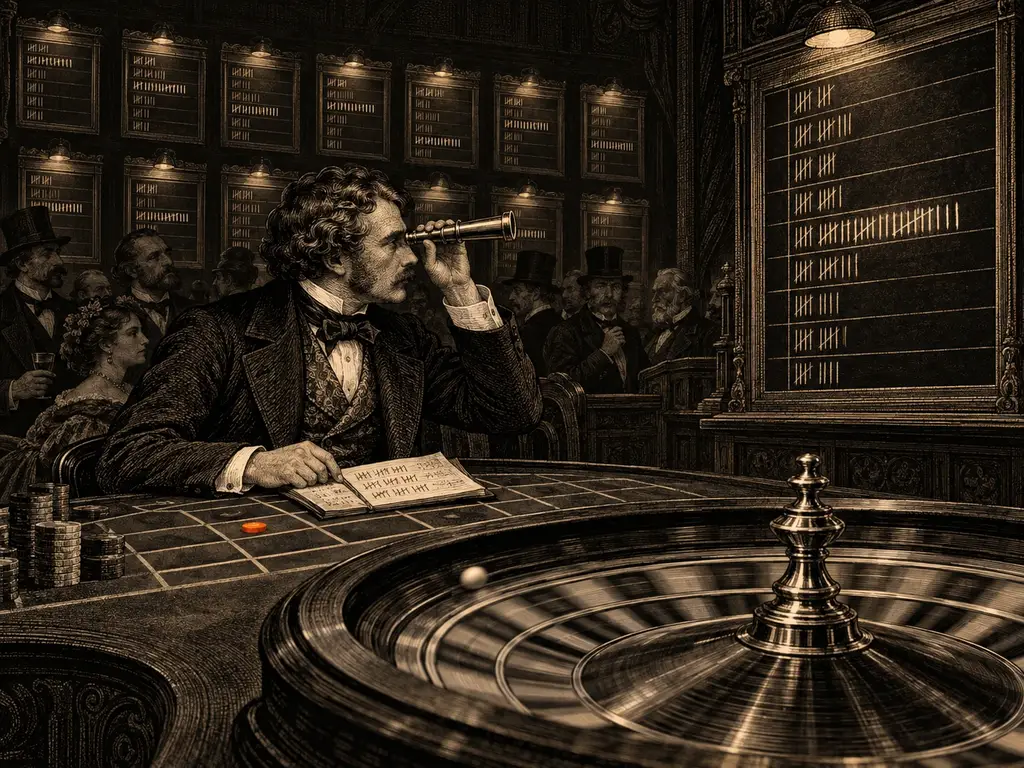
Every wheel shows a “hot” number after 37 spins, biased or not: the busiest number has usually come up three or four times by chance alone. Betting it straight up for the next 37 spins costs 2.70% of every chipmoneyChipA token representing a fixed amount, placed on the layout to make a bet. Also: check.Read full →, like any other number, and even on a genuinely biased wheel a 37-spin look finds the biased pocket only about one time in twenty.
How is the Andrucci system played?
Write down every result for 30 to 37 spins, betting small on even-money chances in the meantime or not at all. Pick the number that came up most often. Then bet one unitmoneyUnitThe base stake a system or a player works in. Progressions are described in units so they apply at any table.Read full → straight upbetStraight upA single number, pays 35:1.Read full → on it for about as many spins again. Some versions follow two or three hot numbersmythHot numberA number that has appeared more often than expected recently. On a fair wheel it predicts nothing.Read full →, and some switch to whichever number leads the count as play goes on. The name has no reliable history: guides credit a Las Vegas player of the 1970s, an Italian statistician or nobody at all, and none of them gives a source.
Why does every wheel have a hot number?
In 37 spins of an unbiased wheel each number appears once on average, but the spins are not shared out evenly. The busiest number has come up exactly three times in 47% of such runs, exactly four times in 40%, and five times or more in 11%. A count of four or more in 37 spins looks like a pattern, and chance alone produces one about every other evening.
What does the betting phase pay?
Once the watching is over, the system is a straight up played 37 times. The chosen number wins with chance 1/37 on each spin, as every number does. It misses all 37 spins in 36.3% of sessions, for −37 units; hits once in 37.3%, for −1; and hits twice or more in 26.4%, for +35 units or better. On average a session loses 1 unit for every 37 staked: 2.70%.
What if the wheel really is biased?
Players who hunt for a biased wheellabBiased wheelA wheel whose physical defects make some pockets more likely than 1/37. Rare, detectable only with thousands of recorded spins.Read full → do look for a number that comes up too often, but they count thousands of spins, not 37. Suppose one pocketequipmentPocketOne of the 37 numbered compartments on the rotor. Also: slot, cup.Read full → comes up once in 30 spins instead of once in 37: a large bias, worth +20% to anyone who bets it. A 37-spin look picks that pocket as the busiest only about 4.7% of the time, against 2.7% for a blind guess, because its few extra hits are lost in the noise. Averaged over whatever the look picks, Andrucci on that wheel still loses about 2.2% of its stake. Finding a bias of that size reliably takes several thousand spins.
Why does it appeal?
It borrows the language of real bias hunting, and sometimes of chaos theory, and it gives the player something to do while the wheel spins. Its one virtue is the flat stake: it wagers no more than any other straight-up player, so it loses no faster than one.
Questions
No. On an unbiased wheel the hot number is a number like any other, and every chip on it costs 2.70%.
In cost, yes. Chasing the hot number and waiting for a “due” cold one are the same straight up at the same price.
Thousands. See How to Detect Wheel Bias and Sample Size.
Fun with Math
Try these yourself first. Each solution is folded; open it when you are ready.
After 37 spins your notebook shows that 23 has come up five times. How unusual is that for 23 in particular? And how unusual is it for the busiest number of those 37 spins to have five or more?
Show the solution
Answer For 23 named in advance, five or more hits in 37 spins happen about once in 327 runs. For whichever number turns out busiest, about one run in nine. The second is the question the notebook actually answers.
For one named number the hits in 37 spins follow the binomial distribution with chance 1/37 a spin. The chance of 0, 1, 2, 3 and 4 hits adds up to 99.69%, so five or more is 0.31%, about 1 in 327.
But nobody named 23 before the spins; it was picked because it came up most. With 37 numbers competing, one of them reaching five is far more likely: about 11% of 37-spin runs, by our simulation (see the table above).
So a count of five is surprising for a number you chose beforehand and ordinary for the leader of the count. Betting the leader afterwards is a straight upbetStraight upA single number, pays 35:1.Read full → like any other, at 2.70%.
Comic relief
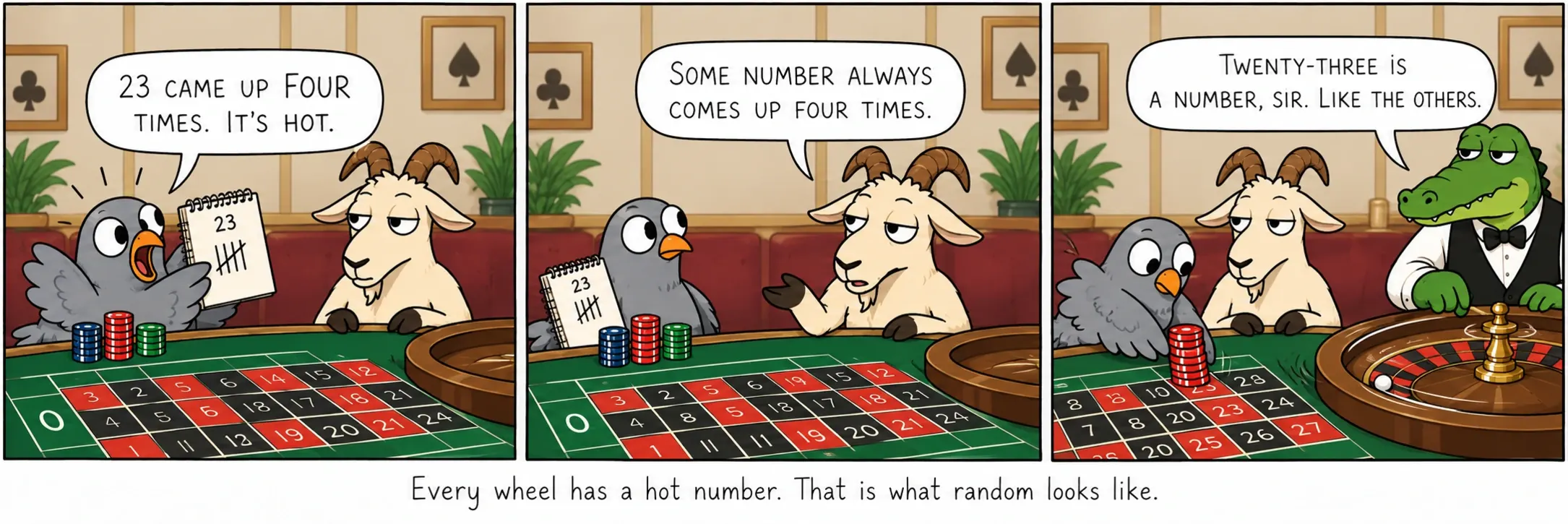
Every wheel has a hot number. That is what random looks like.
Sources
- Ethier, S. N. The Doctrine of Chances: Probabilistic Aspects of Gambling.
- Barnhart, R. T. Beating the Wheel.