Hedging and Covering Bets
Betting against yourself to “cover” outcomes feels safe. It is the same 2.70%, paid on more chips.
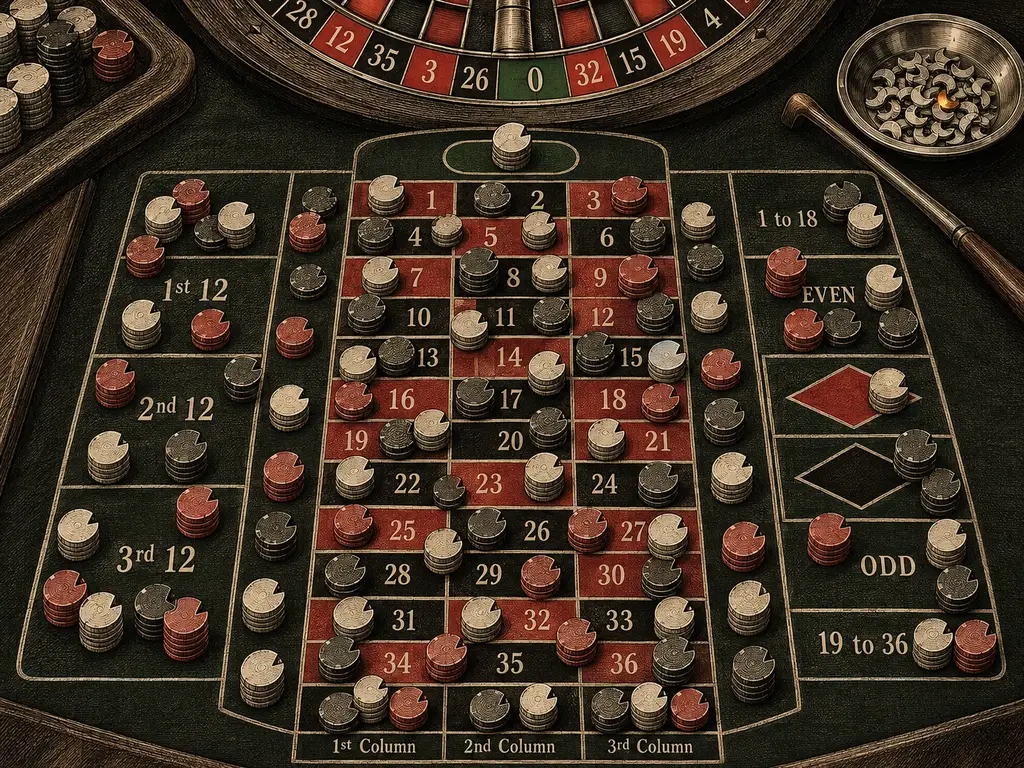
Hedges such as red plus the third column, two dozens plus zero, or red plus black change the distribution of a spin and never its expected value. Covering more numbers raises the hit rate and lowers the payout in exact proportion.
The idea
A player bets redbetRedEven-money bet on the 18 red numbers. French: rouge.Read full → and worries about the blackbetBlackEven-money bet on the 18 black numbers. French: noir.Read full → numbers in the third columnbetColumnTwelve numbers in one vertical column of the layout, pays 2:1.Read full →, so adds a chipmoneyChipA token representing a fixed amount, placed on the layout to make a bet. Also: check.Read full → there: now 26 numbers win something. Another bets two dozensbetDozen1–12, 13–24 or 25–36, pays 2:1.Read full → and adds zerowheelZeroThe single green pocket that no even-money, dozen or column bet covers; the source of the house edge. Also: single zero, 0.Read full → for insurance. Another, in a famous example of the genre, bets red and black together. Each move covers more of the wheel and feels like reducing risk. In the sense of variancemathVarianceA measure of how widely results spread around the expected value. High for straight up, low for even-money bets.Read full → it is; in the sense of expected lossmathExpected lossExpected value times total amount wagered; the average amount lost over a session or a period.Read full → it is paying for a second bet.
The arithmetic
Expected valuesmathExpected valueThe average result per bet over the long run. −1/37 of the stake for every standard European bet.Read full → add. Red is −1/37 of its stake; the column chip is −1/37 of its stake; together they are −1/37 of the total. The hedge has bought a higher hit rate and a lower net payoutmoneyPayoutWhat a winning bet returns, quoted as “X to 1” on top of the returned stake.Read full → per hit at exactly the fair exchange rate minus 2.70%. The Bet Builder tool enumerates all 37 outcomes for any set of chips and shows the distribution and the (unchanging) EV.
Red plus black
The limiting case. Every spin but zero returns the stake; zero loses both. Expected value −2.70% of the total, upside zero. It is the only roulette combination that is strictly pointless, and it is placed more often than you would think, usually by someone hedging a system mid-cycle.
A system with a name: Bohemia (1959)
In 1959 the Cuban magazine Bohemia printed a system that John Scarne later reported and took apart: one unitmoneyUnitThe base stake a system or a player works in. Progressions are described in units so they apply at any table.Read full → on black and one on the third column, which holds eight red numbers and only four black ones (6, 15, 24, 33). Its sellers promised a profit of 4 units every 38 spins of a double-zero wheel; counted honestly, the same wheel gives a loss of 4. Count the outcomes on a European wheel. A black number in the third column wins both bets, +3; a red one wins the column and loses black, +1; any other black wins black and loses the column, 0; the other ten reds and the zero lose both, −2. Over 37 spins that is 12 + 8 + 0 − 22 = −2 units on 74 staked, 2.70%, as for every combination. The system wins or breaks even on 26 spins in 37, which is what made it look clever. Bollman (2024) adds a three-two version, 3 units on black and 2 on the column, at the same price.
Hedging a progression
Players deep in a MartingalestrategyMartingaleProgression that doubles the bet after each loss. See the Strategy section for what it does and does not do.Read full → sometimes split the big bet across red and a dozen, or add zero, to “protect” it. The protection costs 2.70% of itself and changes which outcomes recover the cycle. It does not change the probabilitymathProbabilityChance of an outcome, from 0 to 1 or 0% to 100%. One number: 1/37 = 2.70%.Read full → that the cycle ends badly; it changes how badly, in both directions. A stop rule is cheaper and works.
When the pattern costs more: a dealer’s sector system
On a double-zero wheel one cover costs more than the rest. Bollman (2021) describes a system a Las Vegas dealer recommended, aimed at two arcs of the American wheel: the eight pocketsequipmentPocketOne of the 37 numbered compartments on the rotor. Also: slot, cup.Read full → 2, 0, 28, 9, 26, 30, 11, 7 and, opposite them, 1, 00, 27, 10, 25, 29, 12, 8. On that wheel the two arcs happen to fall into layoutequipmentLayoutThe printed betting grid on the table. Also: table, felt, cloth.Read full → blocks, so three chips cover them: one on the five-number bet (0, 00, 1, 2, 3), one on the six linebetSix lineSix numbers in two adjacent rows, pays 5:1. French: sixain.Read full → 7–12 and one on the six line 25–30. That is 17 numbers, the two arcs plus 3, for three chips. The catch is the first chip. The layout has no bet on 0, 00, 1 and 2 alone, and the five-number bet is the one American bet priced at 7.89% instead of 5.26%. It pulls the whole pattern to −7/38 of a unit on 3 units staked, 6.14%. On an American table, any cover that leaves out the five-number bet costs 5.26%; this one costs more because it includes it.
When covering is reasonable
When the shape is what you want: a high hit rate for a long, quiet session, with the understanding that the price is unchanged. The James Bond spread and two-dozens play are honest versions. The dishonest version is any pamphlet that says a cover pattern “cannot lose”; the arithmetic says every pattern loses 2.70% of what it stakes.
Questions
Only even-money betsbetEven-money betRed/black, odd/even, high/low. 18 numbers, pays 1:1.Read full → on a French table, at 1.35%. Adding other bets to them raises the blended edge.
Yes. That is what it buys, and the only thing.
It is two bets with EV −2.70% each. They are delighted.
Comic relief
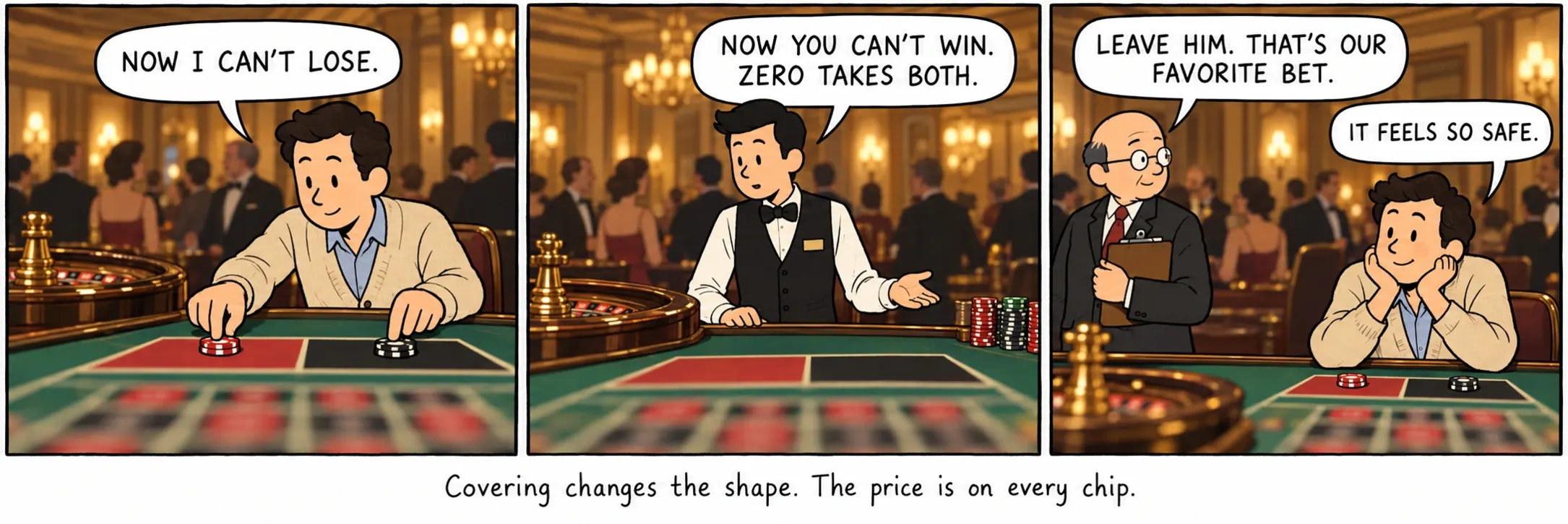
Covering changes the shape. The price is on every chip.
Sources
- Ethier, S. N. The Doctrine of Chances: Probabilistic Aspects of Gambling.
- Bollman, M. Mathematics of the Big Four Casino Table Games: Blackjack, Baccarat, Craps, & Roulette.
- Bollman, M. Basic Gambling Mathematics: The Numbers Behind the Neon, 2nd ed.
- Epstein, R. A. The Theory of Gambling and Statistical Logic, 2nd ed.
- Scarne, J. Scarne’s Complete Guide to Gambling.